


“The art of smoking a pipe is smoking it fast enough to keep it lit, but slow enough that it doesn’t get hot,” is what Tim Davis told me as I stood at his counter, inspecting a row of beautiful English and Italian pipes, their dark briar bowls polished smooth or sand-blasted with a rugged texture.
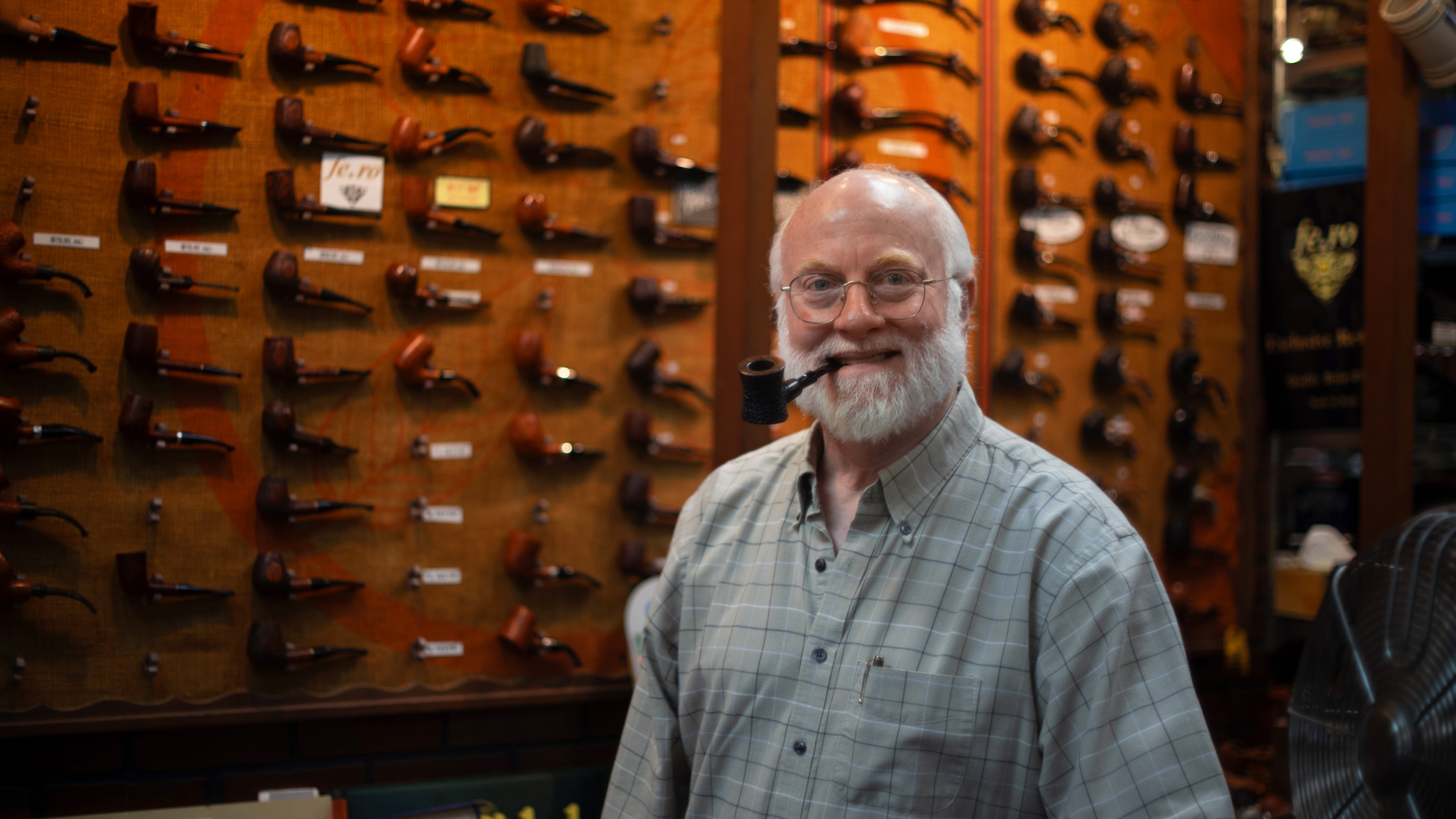
It struck me as pretty good advice for life as well: applying just enough pressure to move things forward, but not so much as to burn yourself out.
Like a sailing yacht heeled hard over under full sail, carrying enough wind to cut through the water with grace and speed, but never enough that she keels over into the sea. In fact, that was almost exactly how Tim looked behind the counter of his shop: an experienced captain at the helm of a ship he had been steering for nearly half a century.
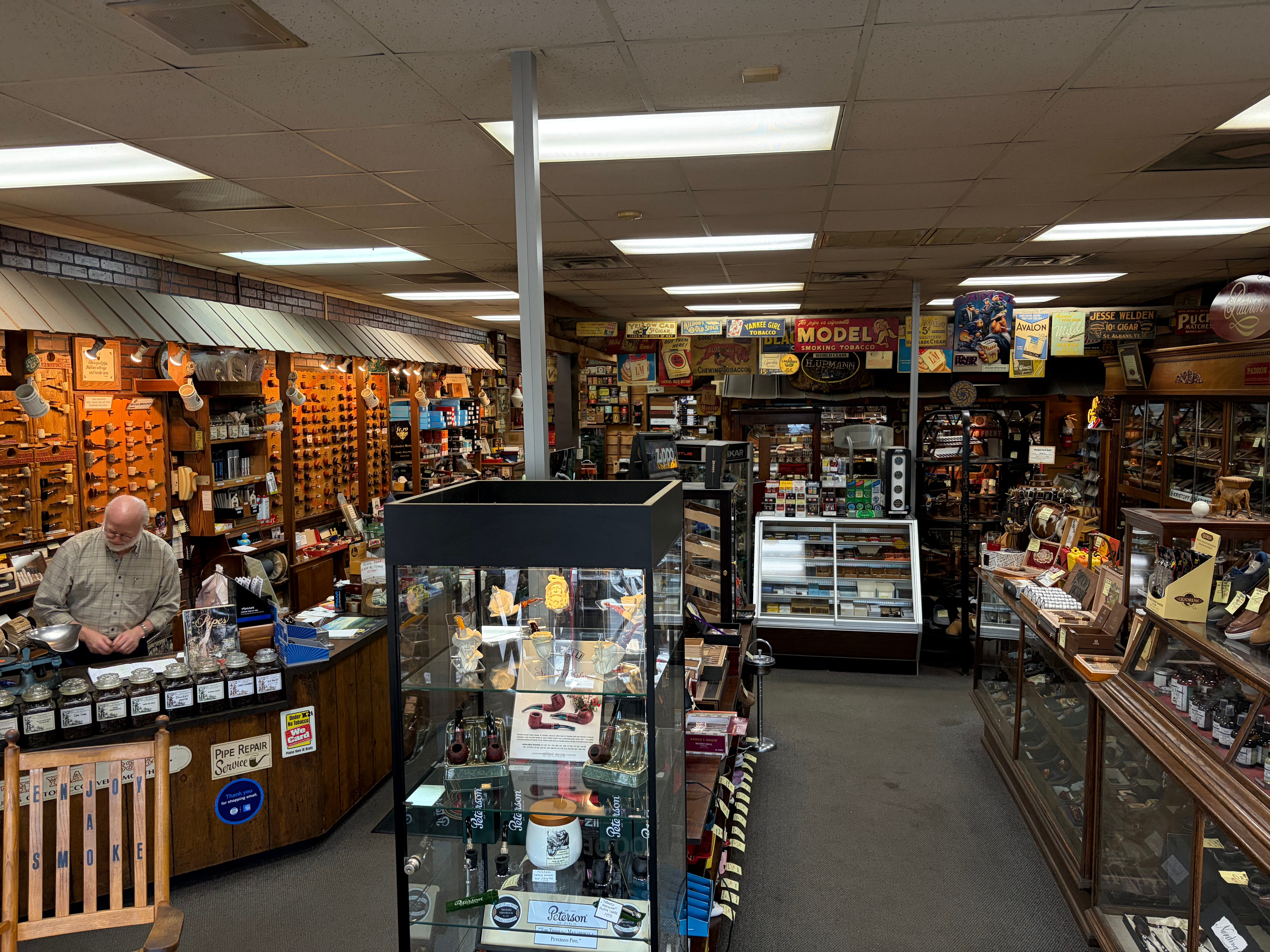
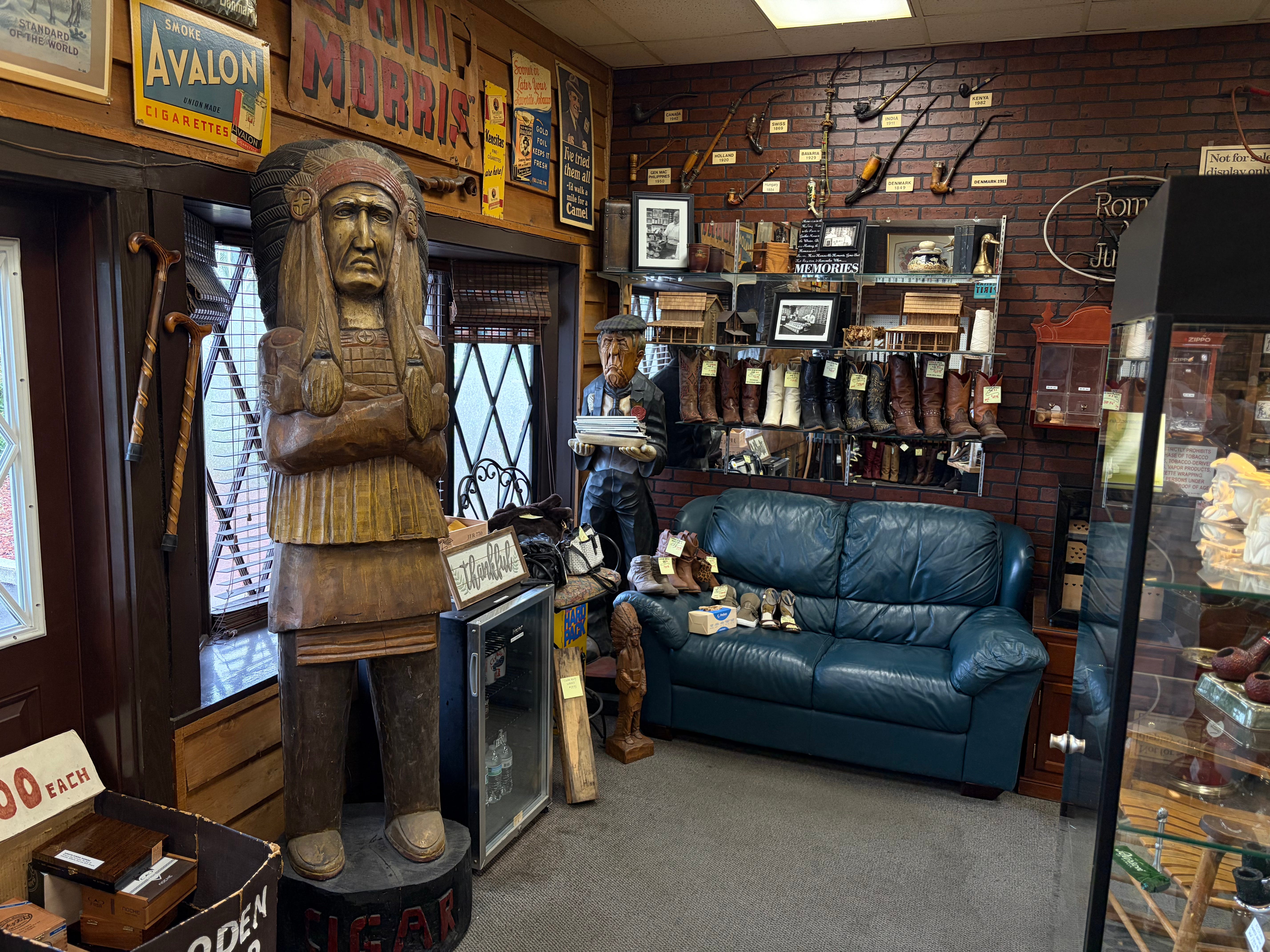
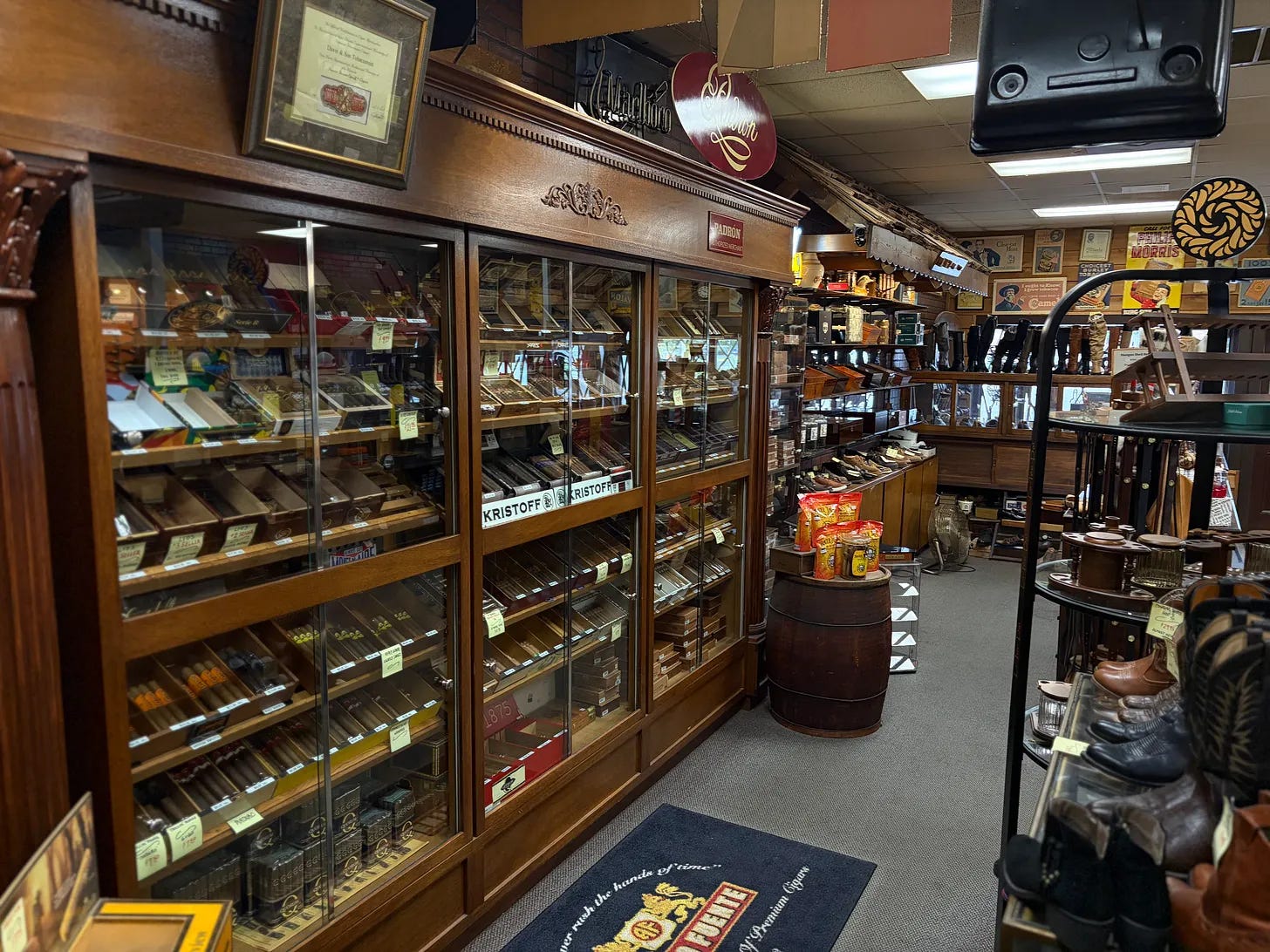
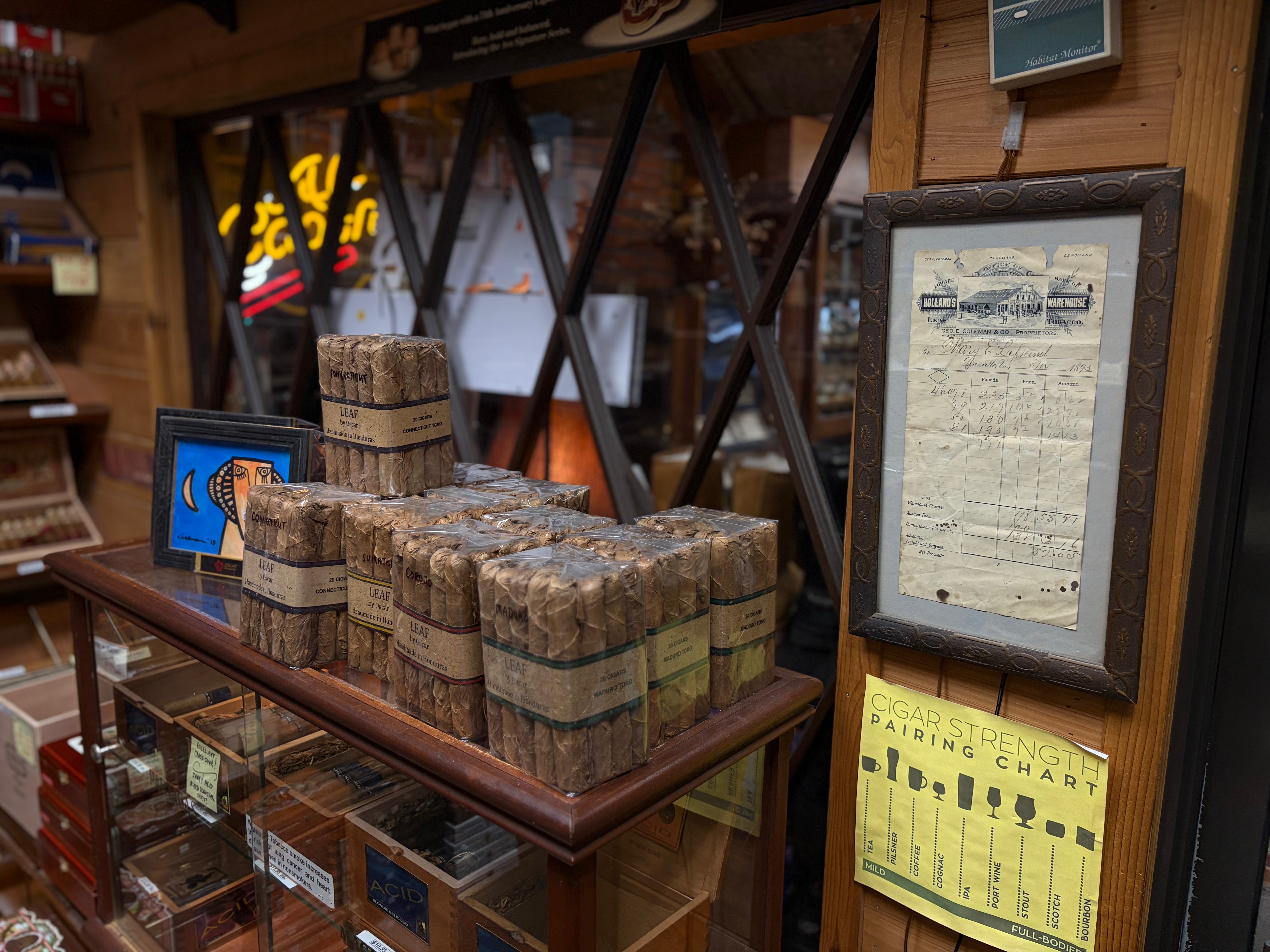
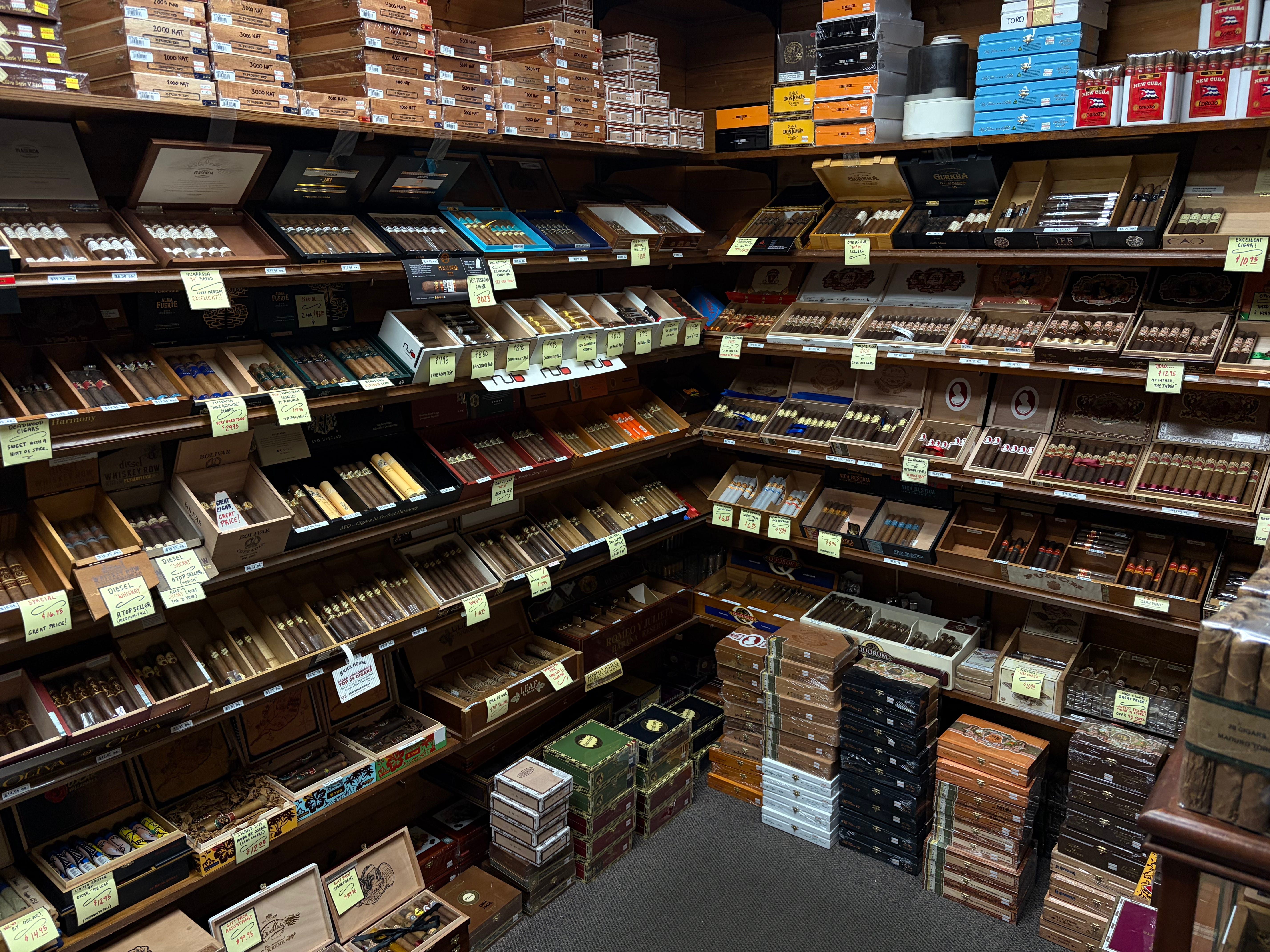
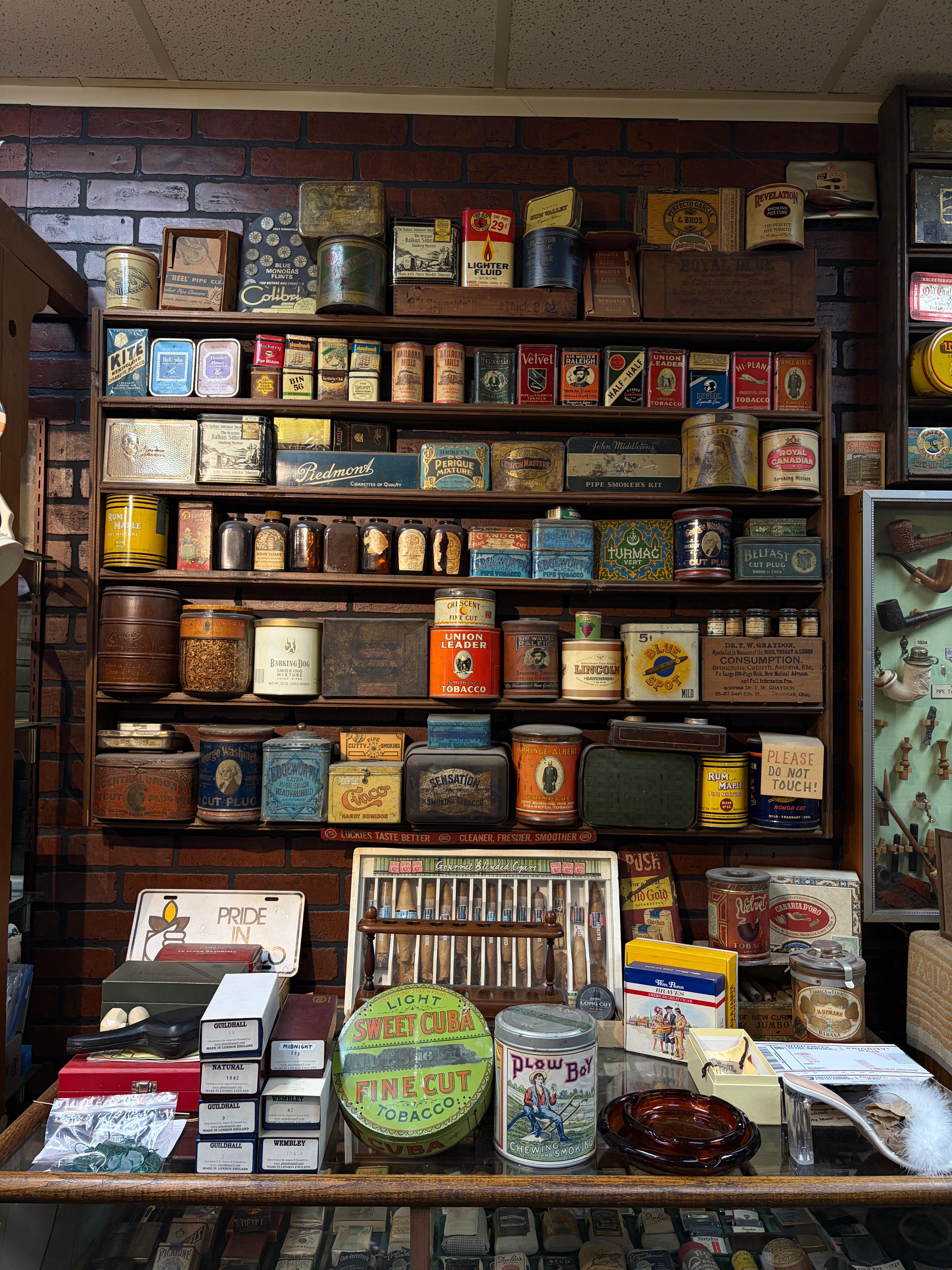
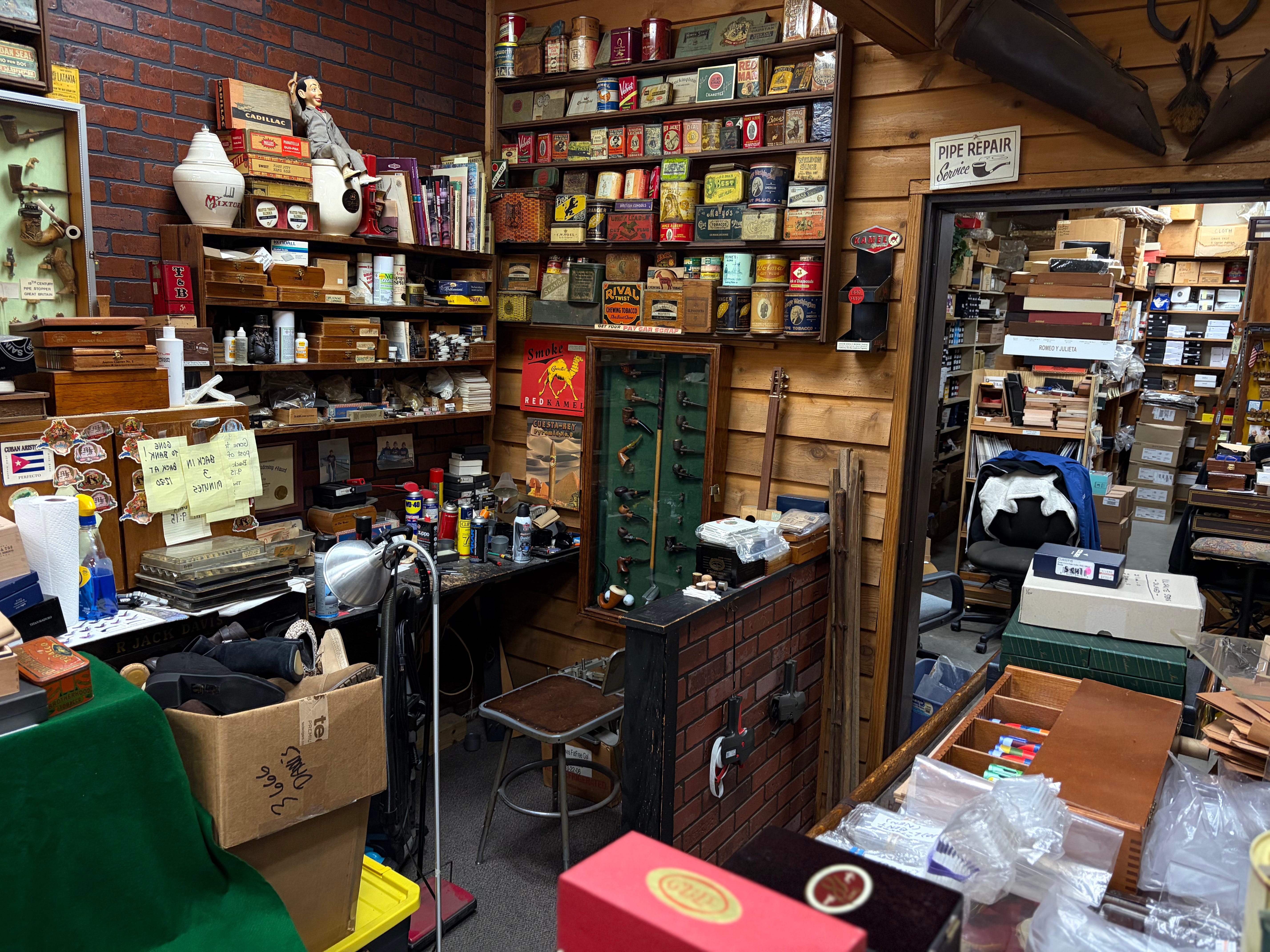
Around him were rows of pipes, jars of tobacco, an old wooden Indian, cedar cigar boxes, lighters, and hundreds of other vintage and modern smoking accoutrements. It was only 7:30 in the morning, so the shop was still relatively quiet, though the phone rang several times and a few customers came through the door.
This is the kind of place that you don’t just stumble upon. Either you’ve been coming here for years, or you seek them out directly. If you look closely above a counter near the back of the store, you see an old Nat Sherman sign that says it all about who Tim Davis is: “I don’t just sell cigars, I’m a tobacconist.”
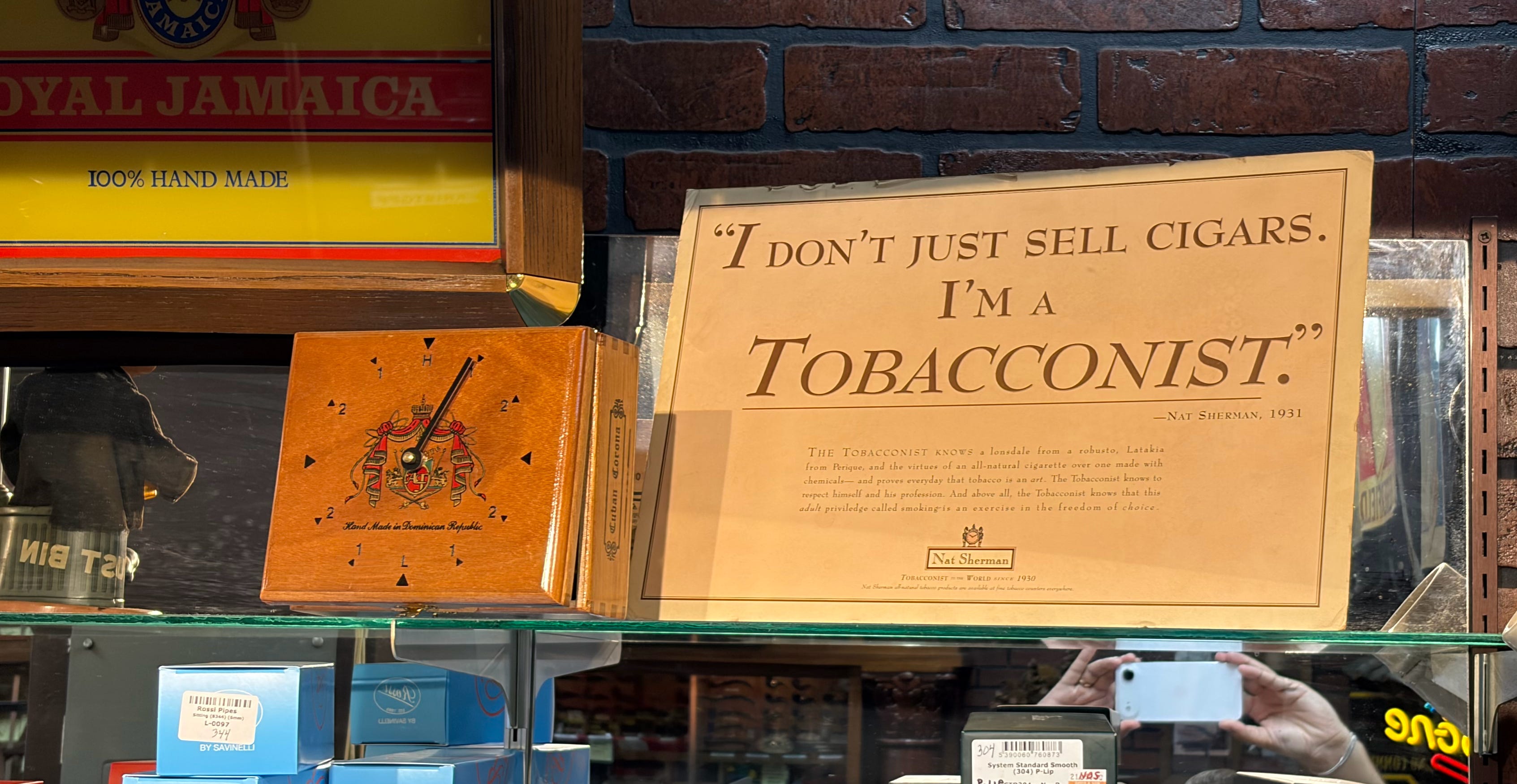
Today, a true tobacconist is a rare thing. There are countless cigar shops in the U.S., Europe, Asia, and the world round. But very few are tobacconists in the traditional sense. Tim told me quite frankly that since the cigar boom of the ’90s, he hasn’t been able to find a single new dedicated brick-and-mortar pipe shop opened in the United States.
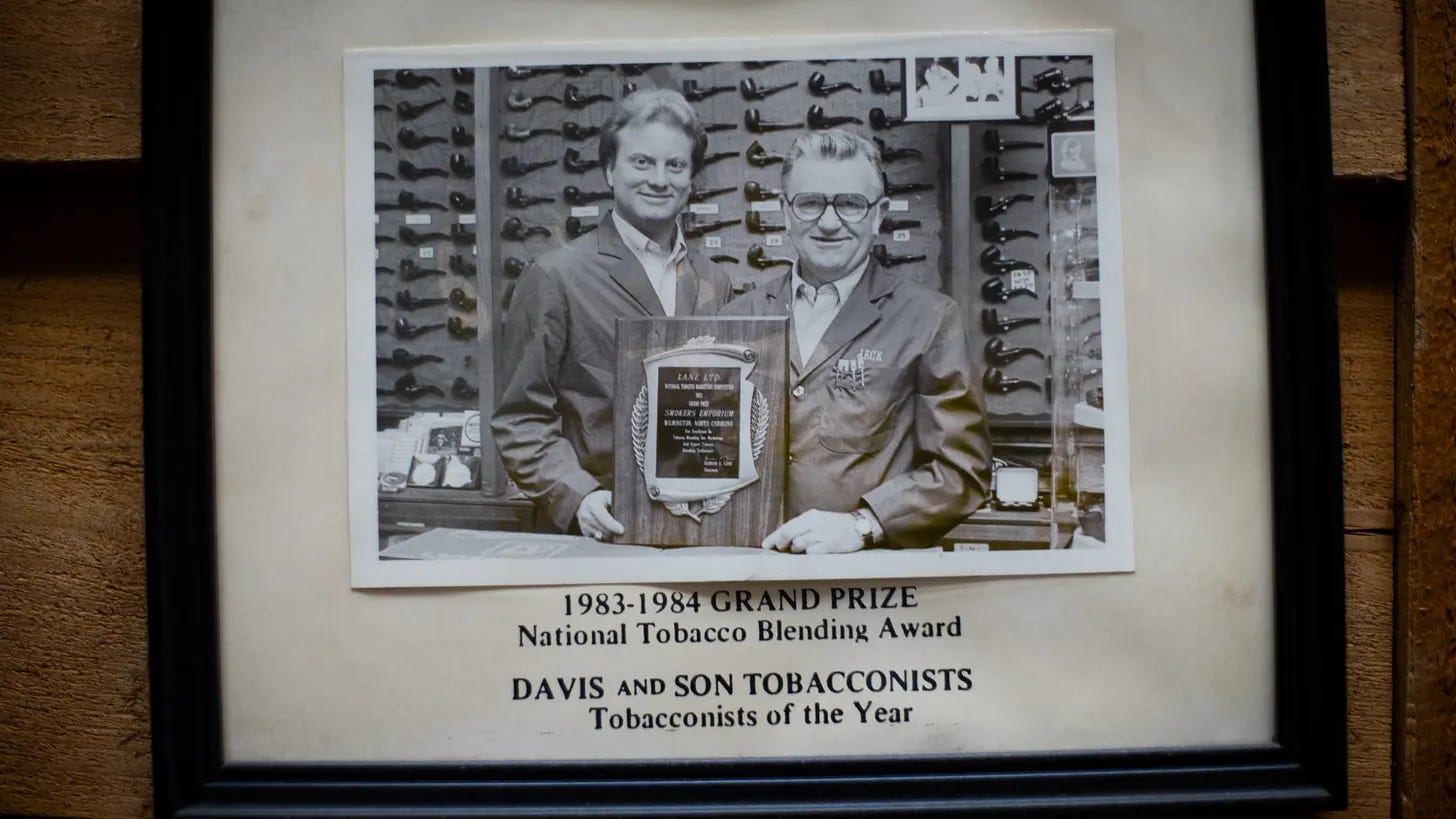
In 1976, Tim’s father opened Smoker’s Emporium in the beautiful North Carolina coastal city of Wilmington, when the American tobacconist looked very different from the cigar-forward shops we know today. Tim joined him three years later, in 1979, and the business became Davis & Son. At the time, roughly three-quarters of what they sold was made up of pipes, pipe tobacco, and the accessories that went along with them. Cigars represented only around 10 to 15 percent of all sales.
The men buying those pipes were not exclusively elderly gentlemen, either. Tim remembers customers beginning somewhere around their mid-thirties and extending through every walk of life, “from farmers to bankers.” There were even eighteen- and nineteen-year-olds coming into the shop to buy pipes of their own. In some cases, Tim believes that was precisely the attraction. A young man smoked a pipe because other young men did not.
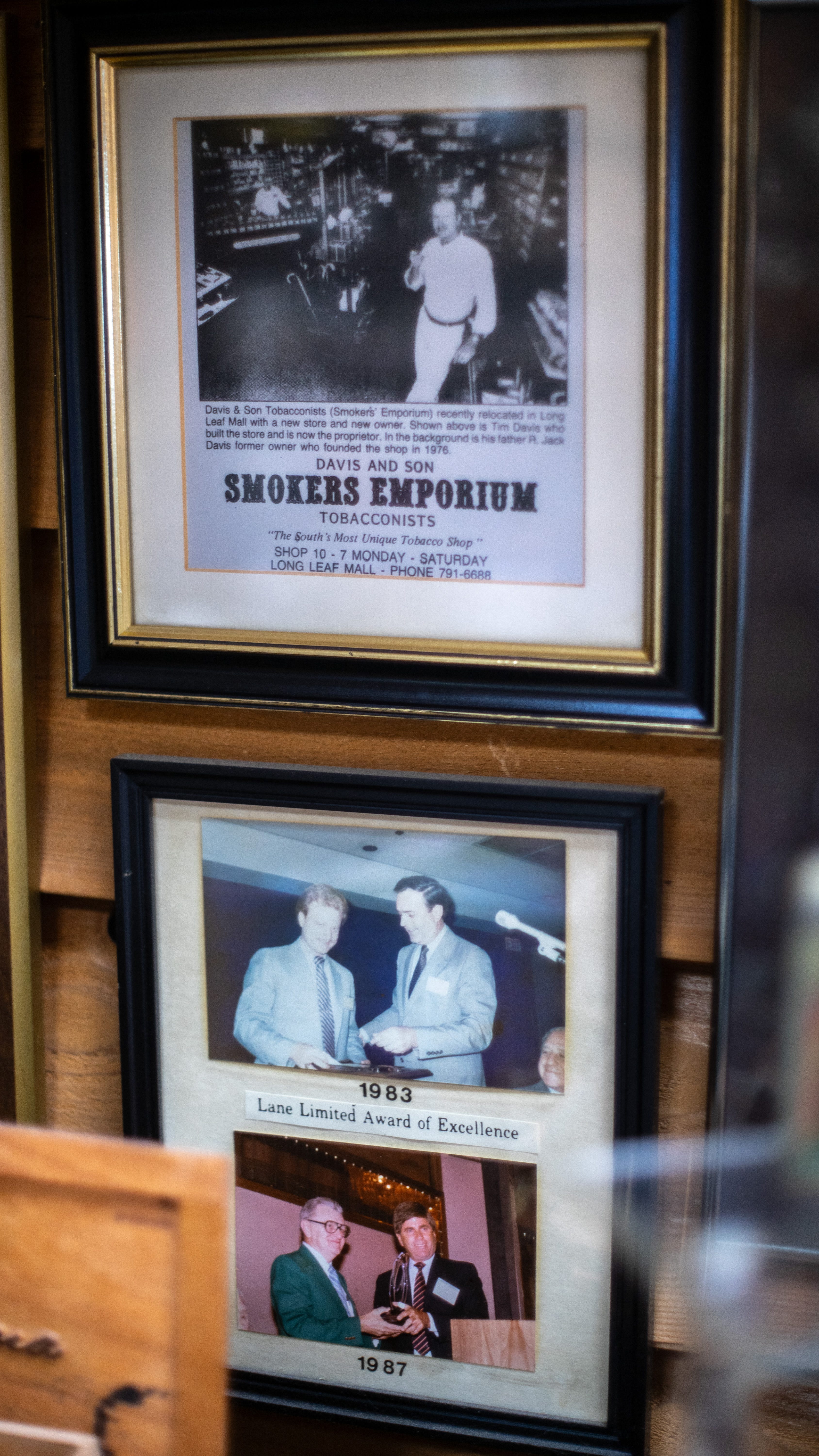
But over the next few decades, that world almost completely disappeared. The cigar boom of ’92, though Tim described it as more of an explosion, shifted the tobacco business heavily toward cigars, and later the internet made it increasingly difficult for traditional shops to justify keeping expensive pipes sitting on their shelves.
Fewer shops carried them, and fewer men smoked them. Whatever lingering customers that existed would often come into the shop, ask to look at an expensive pipe, and then walk out of the store and buy it online. Eventually there were very few men left who even had the knowledge to smoke a pipe, let alone teach their sons.
Tim’s love for pipes would become even more evident later on, but as he explained, he wasn’t the pipe guy in the beginning. “I’ve always smoked cigars,” he told me. “When I joined my dad, he was the pipe guy. I was a cigar guy.” His father, on the other hand, seemed almost inseparable from his pipe. Tim remembered him working behind the counter and carrying on entire conversations with one still comfortably in his mouth.
But now, nearly fifty years later, pipe smoking has all but disappeared. Or at least, that is the direction things seemed to be going, until something very strange happened. Something that would change the course of this shop’s history, and, to some extent, pipe smoking in general.
“For the past thirty years, they haven’t had anyone to teach them,” Tim told me. That, more than anything, seems to explain what happened next.
One day, about six months ago, Tim’s wife was watching her husband explain some technical aspect of a pipe to a customer when she had the idea to film him. Tim didn’t even know she was doing it. She posted the video to the shop’s largely dormant Instagram page, then filmed a few more of these little interactions over the following days. Tim’s knowledge and obvious passion came through on camera, and things started to happen.
The first four did nothing particularly remarkable. Then she posted the fifth. Within a couple of days, it had been watched roughly 50,000 times.
That was when Tim began to realize there might be something much bigger going on. He and his wife started making the videos intentionally, sitting down and answering the kinds of questions he had been answering across his counter for nearly fifty years. How to pack a pipe. What tobacco to buy. How to fix a loose stem. How to choose your first pipe.
The numbers kept climbing. One hundred thousand views. Five hundred thousand. One video eventually reached roughly 2.5 million. And then people started showing.
Within the first week of this explosion of attention, two gentlemen from Tampa got on a plane and flew to Wilmington for the sole purpose of meeting Tim. They had watched only a handful of his videos, but said they’d learned more in those twenty-or-so minutes than they’d been able to learn anywhere else. They spent some time in the shop, bought a few pipes, talked with Tim, and then flew back to Florida the same day.
They were only the beginning. Since then, people have driven in from Texas, Missouri and Michigan, and one customer recently arrived from North Dakota. Some have driven hours out of their way simply because, as Tim explained, they knew they might never again have the chance to visit a real pipe tobacconist in person.
That’s why I consider myself lucky, because Wilmington is where I grew up. My grandfather came to Tim’s shop in the ’80s to buy cigars, and my dad has been coming here since before I was born. I remember on Saturdays, sometimes after my baseball games, my dad would take me by the shop while buying his cigars and occasionally pipe tobacco. I remember the wooden Indian sitting out front and the bubble-gum cigars my dad would buy for me.
My dad would smoke a pipe inside the house at Christmas, something my mother would never have permitted with a cigar. I had always remembered that she actually liked the smell of pipe smoke, and standing there with Tim, that memory suddenly came back to me when he said:
“A pipe is very pleasant. Most women don’t mind a man smoking in the house, because it’s kind of like a burning candle. With a lot of women, it brings back good, fond memories of lost or past loved ones—their grandfathers, their uncles, their fathers.”
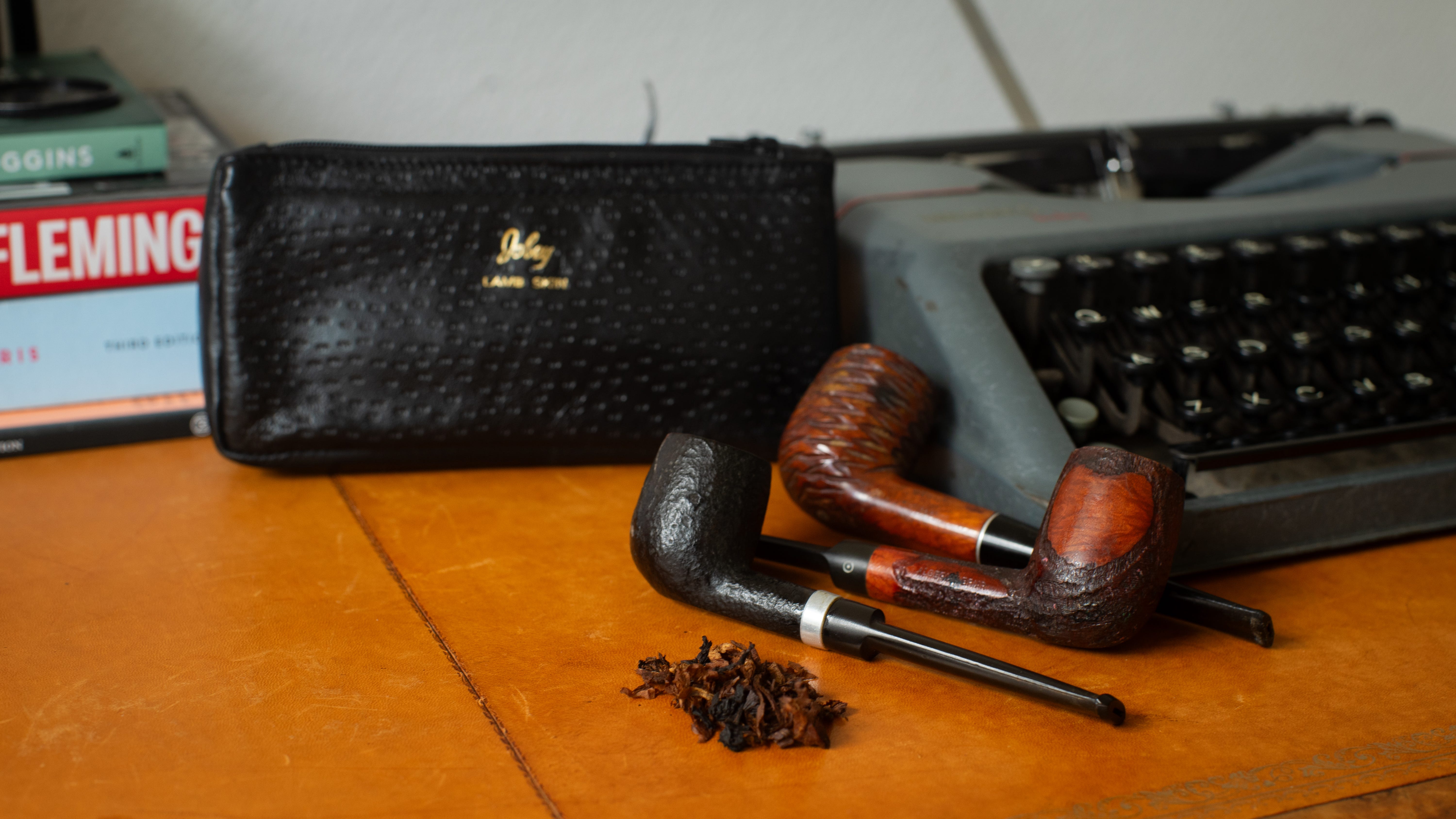
For my mother, that smell brought back her own father, who had fought in North Africa during the Second World War and smoked a pipe at home. It was a fond enough memory that pipe smoke was always treated differently in our house. Years later, she gave me his pipes, dating back to the 40s, and I still smoke them myself.
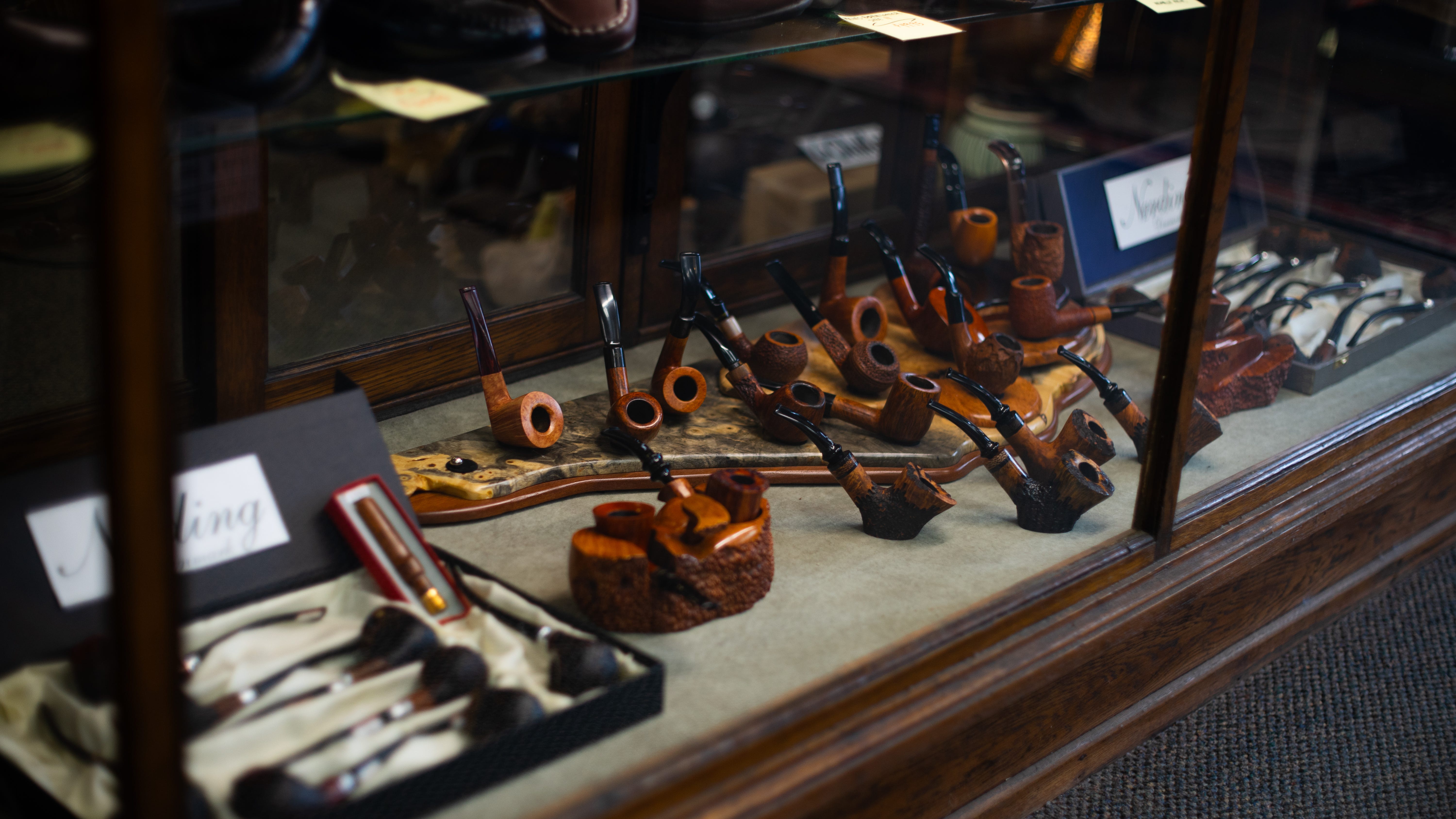
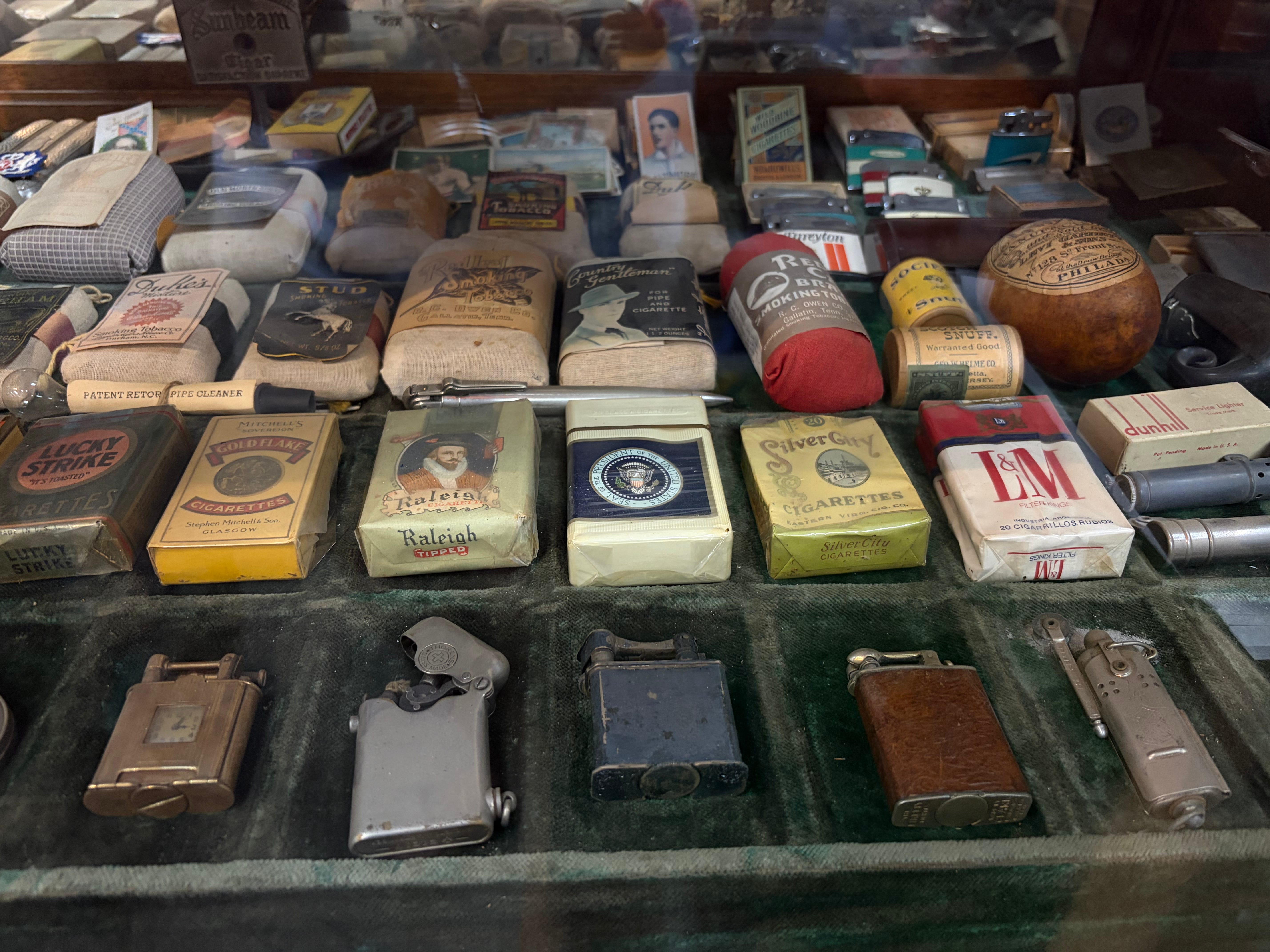
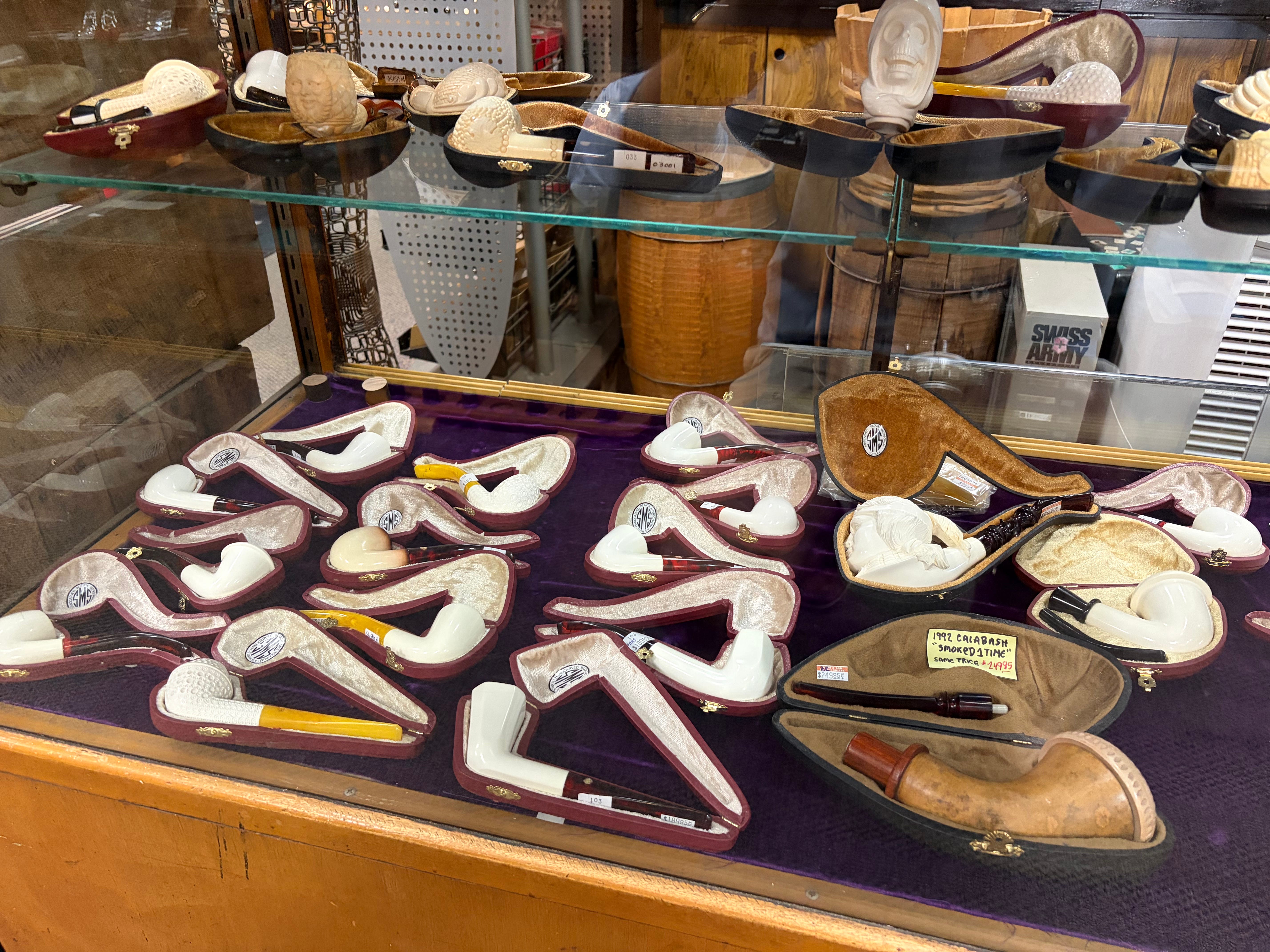
Now, standing there looking at all these pipes, I had so many questions that my eyes hardly knew where to settle. Tim’s store is filled with English-made safety razors by Parker, leather shoes, unopened packs of cigarettes from the ’30s, antique display cases, old cigarette and pipe-tobacco advertisements and antique Meerschaum pipes, which are something of a specialty of Tim’s.
One of the display cases is even an old Remington gun case from the ’30s. Stepping inside, the cool air and wonderful smell hit you immediately, while somehow never smelling particularly smoky.
As we inspected the pipes together, I asked Tim how I could tell whether I was in the hands of a genuinely good tobacconist.
“Well, I think the main thing is, look for the quality pipes. Everybody has cigars, but not that many stores have good quality pipes anymore.”
He reached over and showed me a pipe that looked normal enough from a distance, but when he put it in my hand I could feel the plastic and see the thimble-like bowl inside.
“Amazon sells a lot of pipes that are made out of pear wood, apple wood. I don’t even know what they are. Some of them are made out of plastic like this one. If somebody buys something like that and smokes a pipe, they’re gonna hate it.”
So what should someone be looking for? I asked.
“Once you’re a veteran pipe smoker, you look to the name brands of pipes that are there.”
When Tim first started working with his father, those names were almost entirely English.
“Back then it was almost entirely English pipes, because those were better quality pipes at the time,” he said, mentioning names like Dunhill, GBD, Comoy’s, Charatan and Ben Wade.
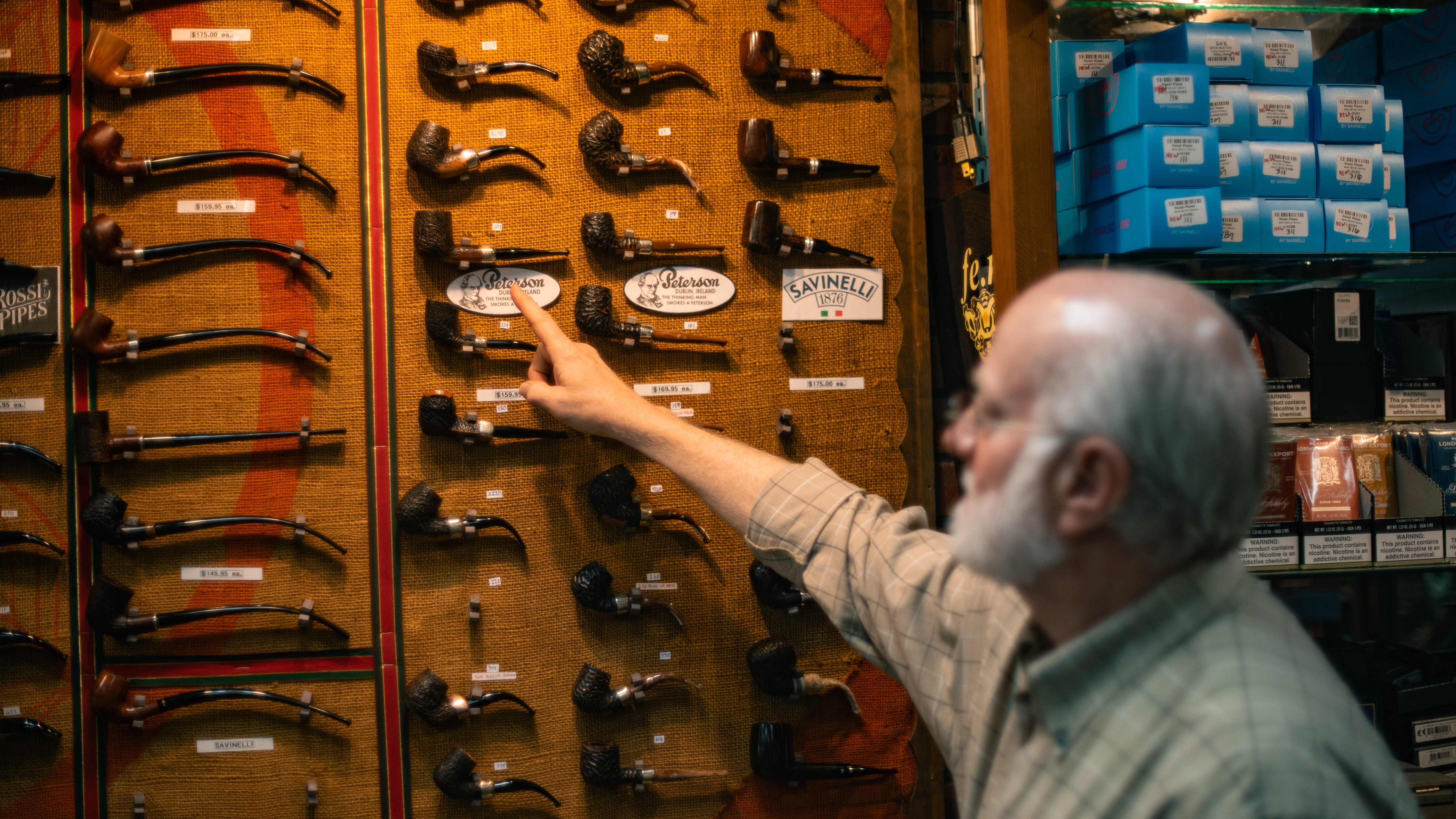
Today, when I asked where he would point someone looking to spend around $100 to $150 on a good first pipe, his answer was Peterson. He pointed out the Petersons from Ireland and the Savinellis from Italy sitting nearby. The Italian makers came later, but today they make up much more of what Tim carries.
From there, we got into the wood itself.
“What I try to teach people is when you look at pipes, especially in our store, ninety-five percent of the cost of the pipe is just for the quality of wood. The quality of the wood makes all the difference in the world.”
And that wood should be briar.
“Briar is very special. Number one, it’s fire resistant. I’ve got pipes that are forty years old, a hundred years old, that are still smoking. But the other thing about briar is that it will dissipate the heat from inside the bowl through the briar and cool off the smoke.”
He began showing me the grain running through several of the pipes behind the counter.
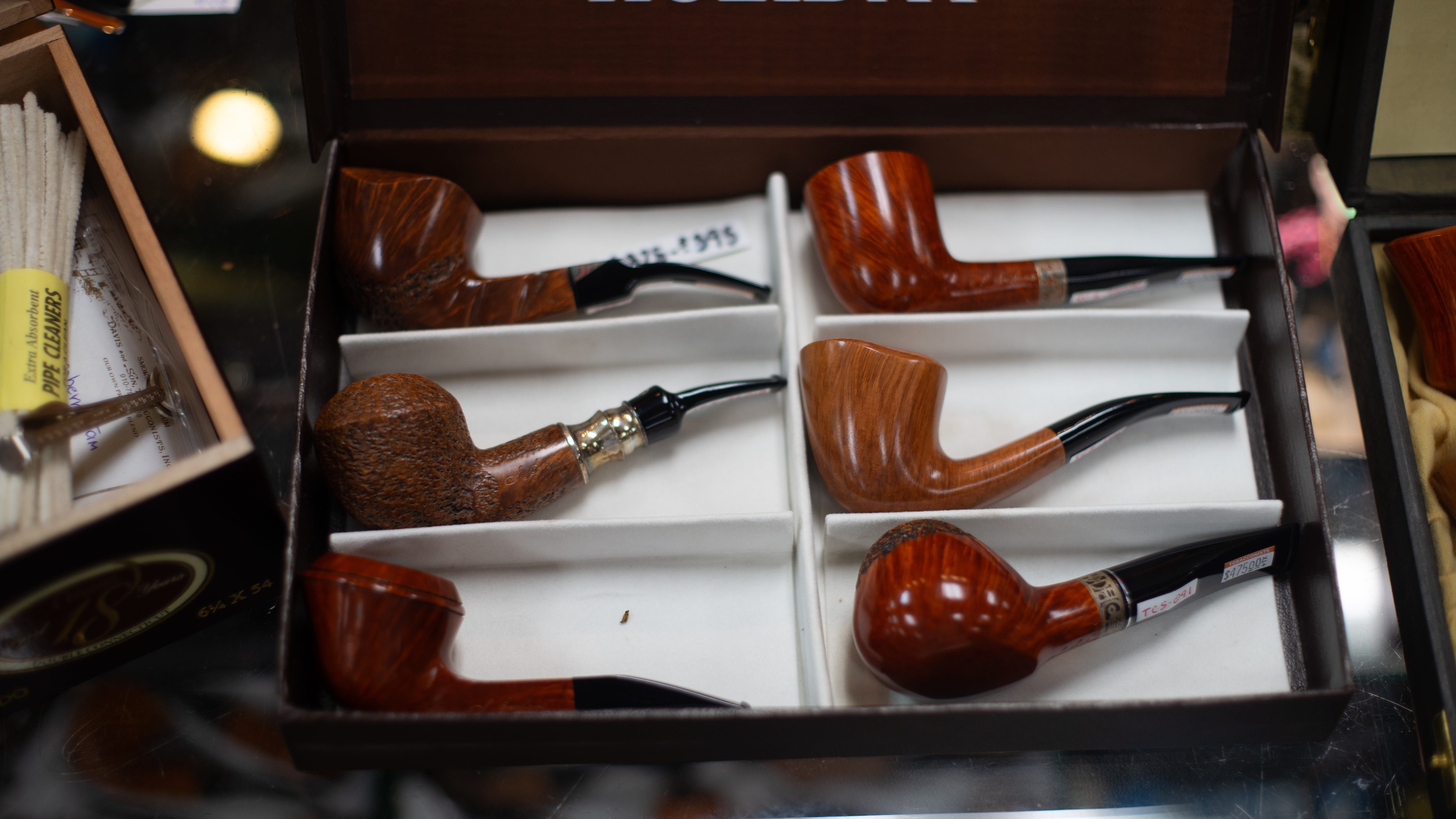
“See how the grain runs straight like this? Straight grains are your most expensive pipes. I’m a wood guy. You look at these pipes, all these have straight grains.”
I asked Tim which pipe he liked best himself. He showed me a Caminetto he had owned for twenty-seven years, a sitter that could stand upright on a table on its own. More than anything, he liked the way it felt in his hand. After all those years, he said, it fit “like a glove.”
Some of the pipes Tim was showing me were not new at all. Or, rather, they had never been smoked, despite being made twenty-five or thirty years ago.
“I buy a lot of new old stock pipes.”
He pulled out several made by Thomas Cristiano, a pipe maker and very good friend of Tim who had passed nearly thirty years ago. Tim had recently been speaking with a dealer who had seen his videos when the man casually mentioned that he still had some of Cristiano’s Signature series pipes, his top-of-the-line creations.
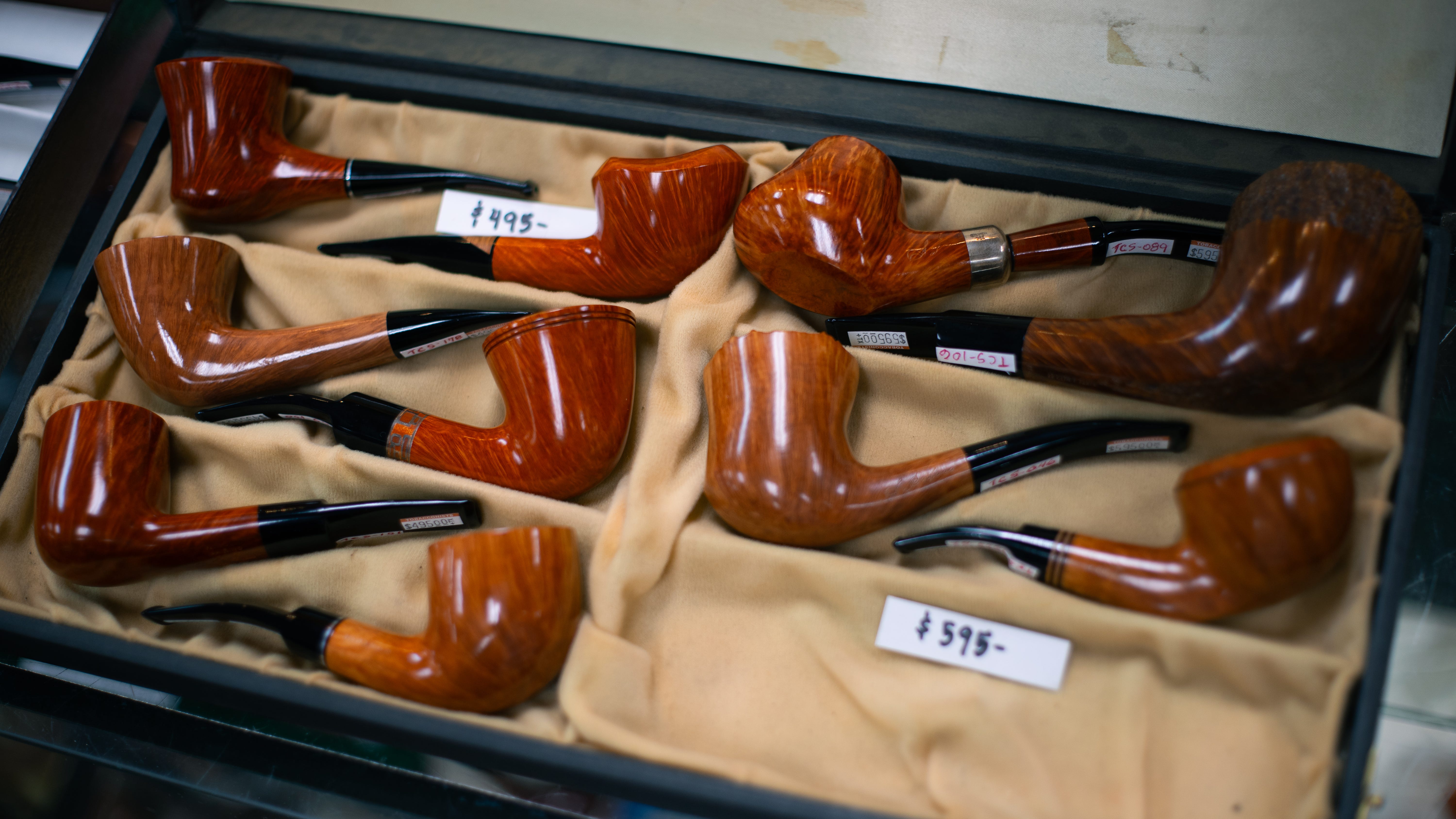
“I asked him, ‘Well, how did you get those?’ He said, ‘I bought them from Thomas Cristiano 30 years ago and never sold them.’”
The pipes had simply been sitting there for decades. Tim bought them and showed them on Instagram and Facebook. Then more sellers with new old stock reached out.
“Once that happened, I had three different stores that called me and said, ‘Hey, I got some Thomas Cristiano. I can’t sell them.’ So I buy them.”
For years, pipes like these had been sitting untouched in the back rooms of old tobacco shops because there was hardly anyone left looking for them. Now Tim suddenly had an audience of people who were. They were essentially brand-new pipes from another era, waiting thirty years for someone to appreciate them.
After inspecting twenty or thirty incredible pipes and hearing Tim wax on about them for the better part of half an hour, I realized I was hooked. I had to buy a pipe today, and there was no way around it. Yes, I know I have 5 already, but who can blame me. This man makes you care. He makes you want to buy them, not because he is selling you, but because he sparks a love for pipes inside you.
“OK Tim, I think I’m gonna have to buy a pipe today. Which one should I be looking at?” I said.
“Oh my gosh, there’s so many of them.”
I told him that normally I simply looked at the wall until I found one I liked the look of. Aesthetics, of course, mattered, but was I making a mistake?
“No, it’s okay.” Tim said “The visual is the most important thing. One thing I learned a long time ago is, with pipe smokers, they’ll come in and look at twelve, eighteen pipes, maybe more. But you know which one they always go back to? The very first one they picked off the wall.”
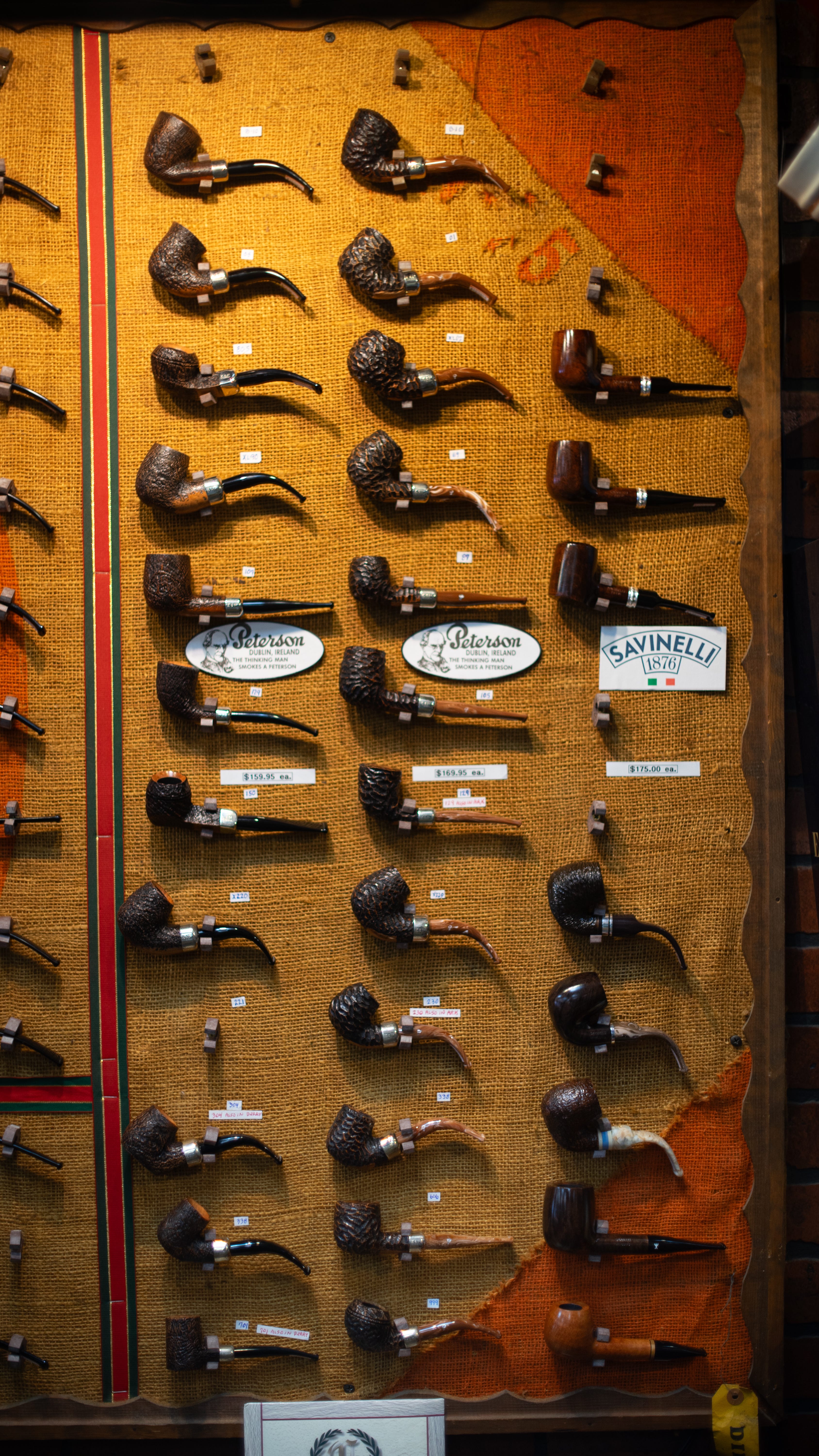
I wanted to test this theory, so we started pulling pipes down, but I was careful to pick the first one. Petersons and Savinellis, bulldogs and straight-stemmed pipes, smooth briar and heavily rusticated finishes. Tim showed me an old-stock Lorenzo and a dark Ben Wade second. I kept gravitating toward the smaller, darker pipes that looked as if they might have been sitting in the same case since the ’30s.
Eventually, one kept finding its way back into my hand.
“That’s a good pipe. That one is new old stock.”
“How old?”
“Probably thirty years old.”
“That’s the one. I love the look.”
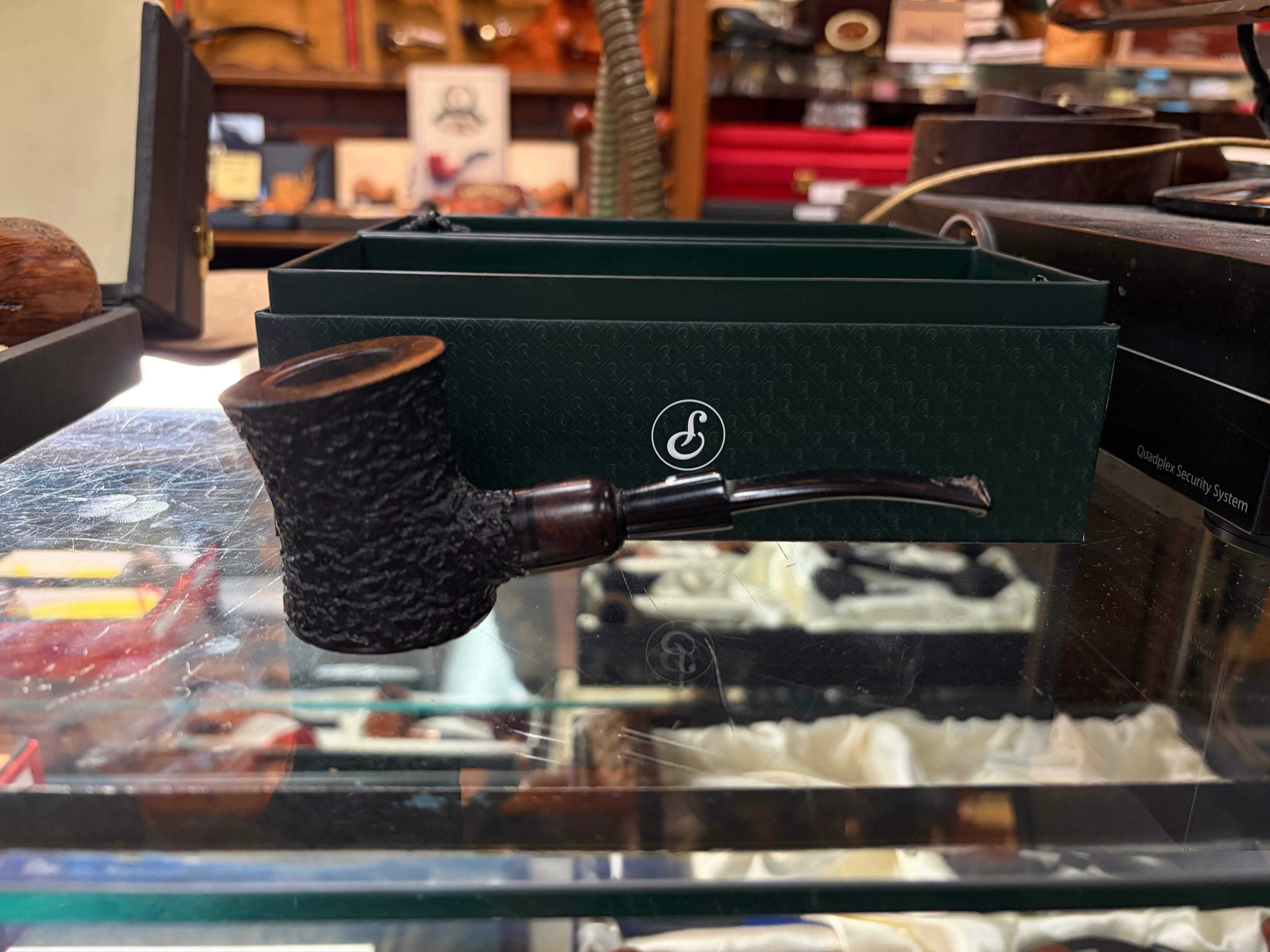
It was a beautiful Italian straight pipe, black and completely unsmoked, with an unusually long briar shank and a very short stem. It had the sort of severe, elegant proportions that immediately looked old to me. Not old-fashioned exactly, but like something a gentleman in the ’30s might have smoked. I could picture it clenched between Errol Flynn’s teeth at the helm of his sailboat or sitting beside Ian Fleming’s James Bond character, M, at his desk at MI6.
Then, as Tim began twisting the stem free, the unthinkable happened. While trying to remove the stem in an effort to sand down the tenon (the part of the stem that goes into the wood) the stem snapped in half.
I could tell he was genuinely upset. He told me this almost never happened and apologized, knowing it was the one I had wanted. It was certainly a shame that, out of the hundreds of pipes in the shop, the one I had picked was the one that broke, but I really wasn’t bothered by it. I was just happy to be there talking to Tim.
Fortunately, he knew exactly how to repair it. I had already made up my mind, so I bought it anyway and left it with him to fix. My dad could come back and collect it once it was ready, Tim said.
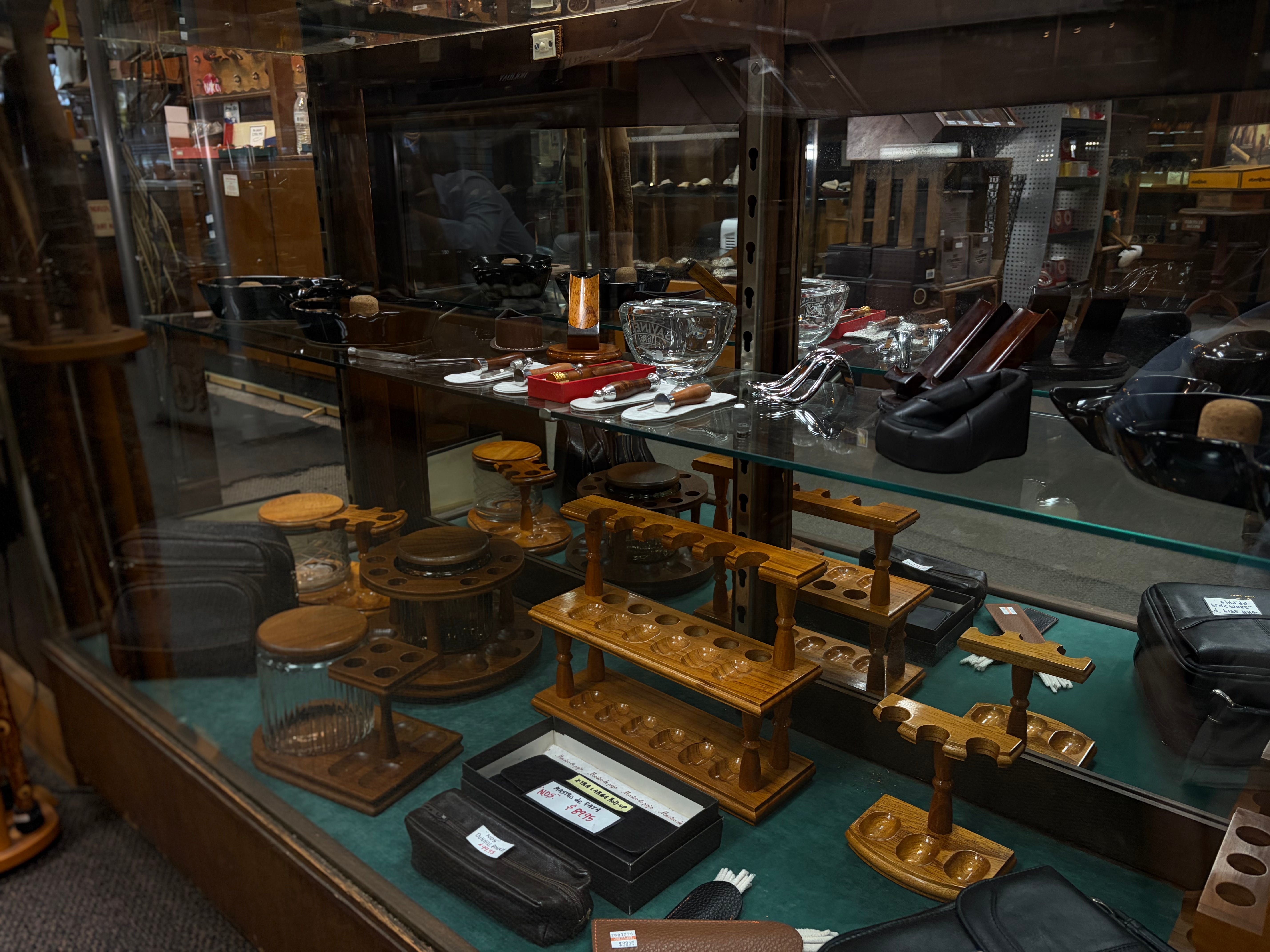
Of course, knowing how to choose a good pipe is only half the battle. I already owned several, including one French-made pipe I had recently bought in Paris, but I admitted to Tim that I still had one persistent problem: I could never seem to keep the damn thing lit without smoking it so quickly that the bowl became blazingly hot.
“My theory is that if I smoke fast enough, I’m keeping it going.” I explained
“Yeah, it’s smoking too fast. It’s just a cadence that you need to learn.”
“The most important thing that we found when packing a pipe is go ahead and pack it all the way down to the bottom, pack it firm, and do a nice, even packing. Don’t have it tight in the center or on the sides. Nice even packing all the way around.”
If it feels too tight, there’s a simple test.
“Put it in your mouth, draw it, and see how it is. What you want is an easy draw, just a little bit of resistance.”
Like many beginners, I had assumed that packing the tobacco loosely would help it stay lit. Fire needs oxygen, after all.
“That won’t work.” He said. “It’s like having a fuse with a lot of holes in it. It’ll burn down and go out, burn down, go out, burn down, go out.”
“That’s why tamping is so important, because you want to compress all that tobacco together to make it a solid unit. Then when you light it and tamp it and light it again, you’ve got one continual burn.”
There’s also one considerably simpler reason a pipe might go out.
“Sometimes people say, ‘I can’t keep it lit,’ but they’re holding their pipe in their hand the whole time. You gotta smoke a pipe to keep it burning.”
Tim also explained that there is a beginning, middle and end to a bowl of tobacco, and that the middle is almost always the best part. That is another reason to fill the bowl properly. I realized I had probably been cheating myself in the past, packing only a few pinches of tobacco when I wanted a five-minute smoke and never really reaching the best part of the bowl.

From there, Tim and I moved on to the tobacco jars. He mixes and curates his own blends of pipe tobacco right there in the shop.
Tim has what looks like more than forty varieties lining the wall, some aromatic and some unflavored. Tim is more of an aromatic smoker himself, and I can’t blame him. His most popular blend by far is Danish Matte, which to me is something like a take on Captain Black, only of a far higher quality.
My eye, however, kept drifting toward the English blends in the upper-left corner of the wall. I knew that was what I wanted to try next.
The last time I was in Paris, I bought a tin of Davidoff English Mixture. It was good, but not quite as good as I had expected. As an Ian Fleming and James Bond obsessive, I have always been fascinated by the old Balkan and Macedonian tobacco mixtures Fleming wrote about, particularly the Morland cigarettes made for Bond with their three gold bands.
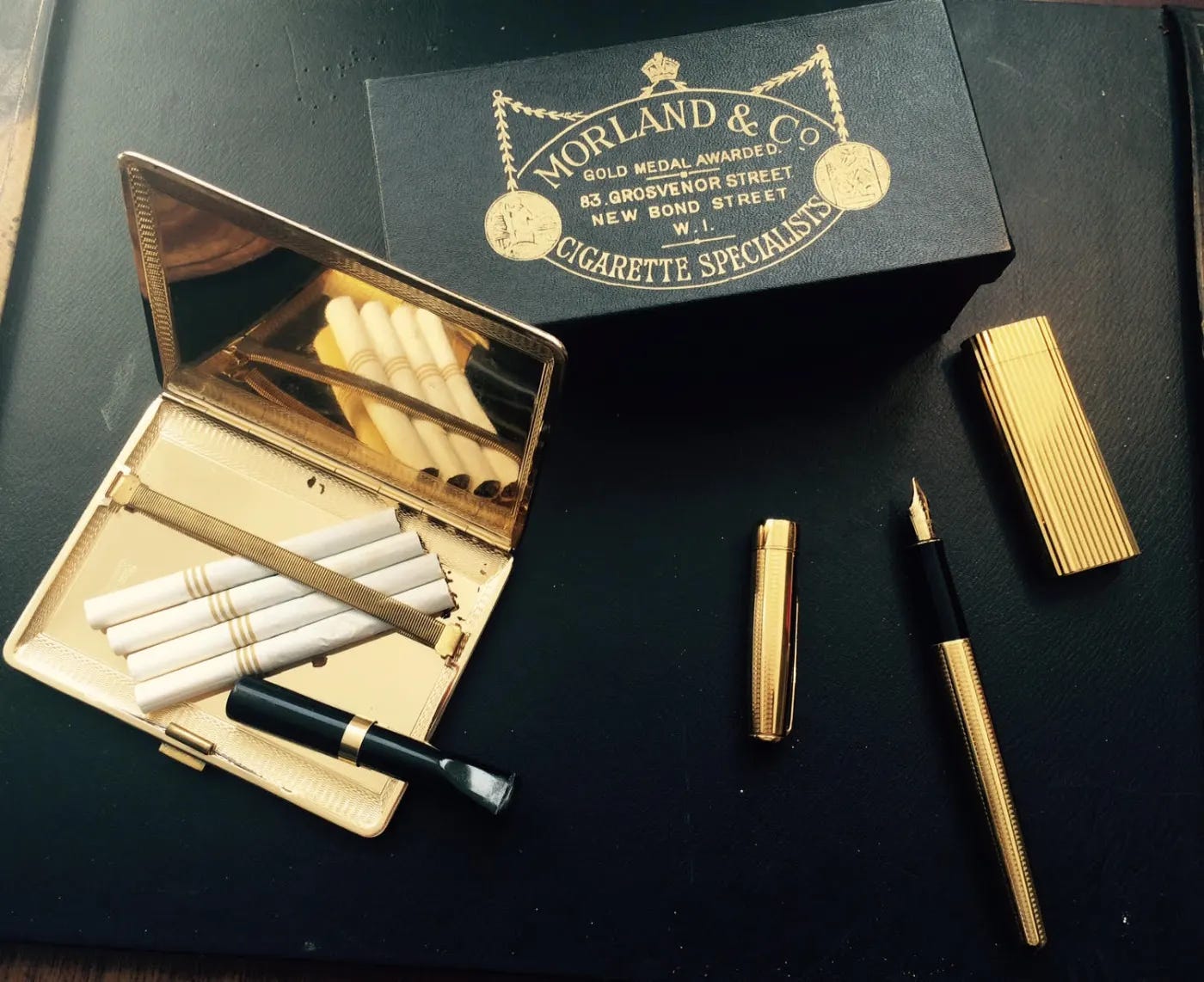
They belonged to an entirely different tobacco tradition from the Virginias and American Burleys I was more familiar with.
So I chose two: English Supreme, a traditional English-style mixture, and Sterling Balkan, a darker blend that smelled immediately richer, smokier and more mysterious.
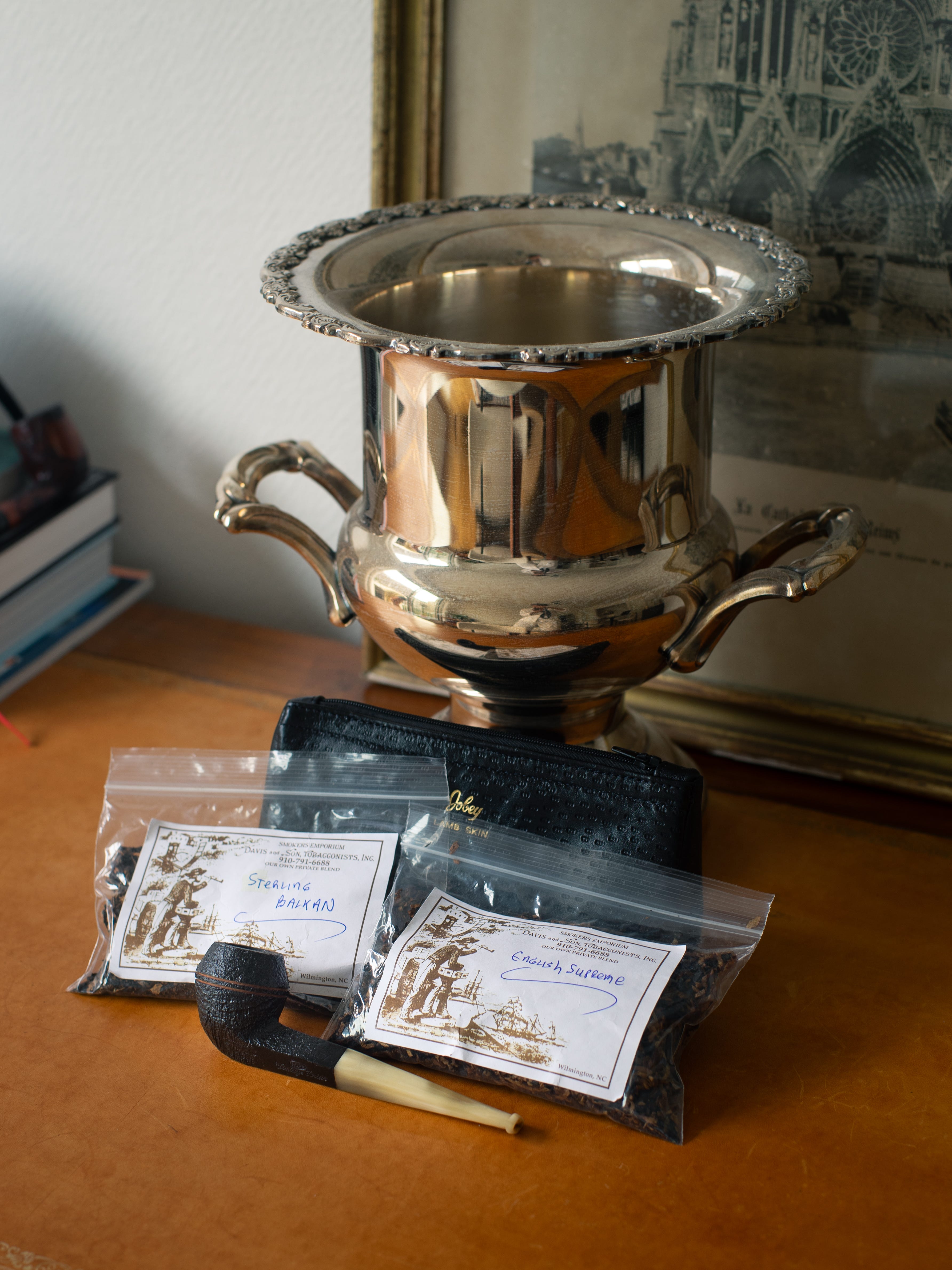
As more customers came into the store, Tim’s morning began to pick up. The phone rang more frequently, and people started drifting through the aisles and into the humidor. As I said goodbye, I glanced back at the cigars and wondered whether I ought to pick up a few.
No, I thought. Today was a pipe day, and it should stay that way.
It was time to step back out into the humid August air.
Tim promised me he would repair the pipe as soon as he could, and that my father could come by and collect it for me. Better yet, the next time I was in Wilmington, I could bring it back to the shop, smoke it with him and let him correct whatever bad habits I had managed to develop.
I liked the idea of that. I made a mental note to do exactly that on my next trip.
To me, the most impressive thing about Tim is that he has stood by something he believed in and loved. Even when customers dispersed and the market shifted around him, he didn’t change to fit a trend. Despite being in the business of making money, he stuck by pipes because he knew they were a great thing, and that they deserved to stay alive.
It reminds me of that State Department clerk who, as the British marched on Washington in 1814, had the foresight amid the chaos to save the Declaration of Independence and the Constitution from the fires consuming the city. It turns out some men can still see the value in things even when everyone else seems to have forgotten.
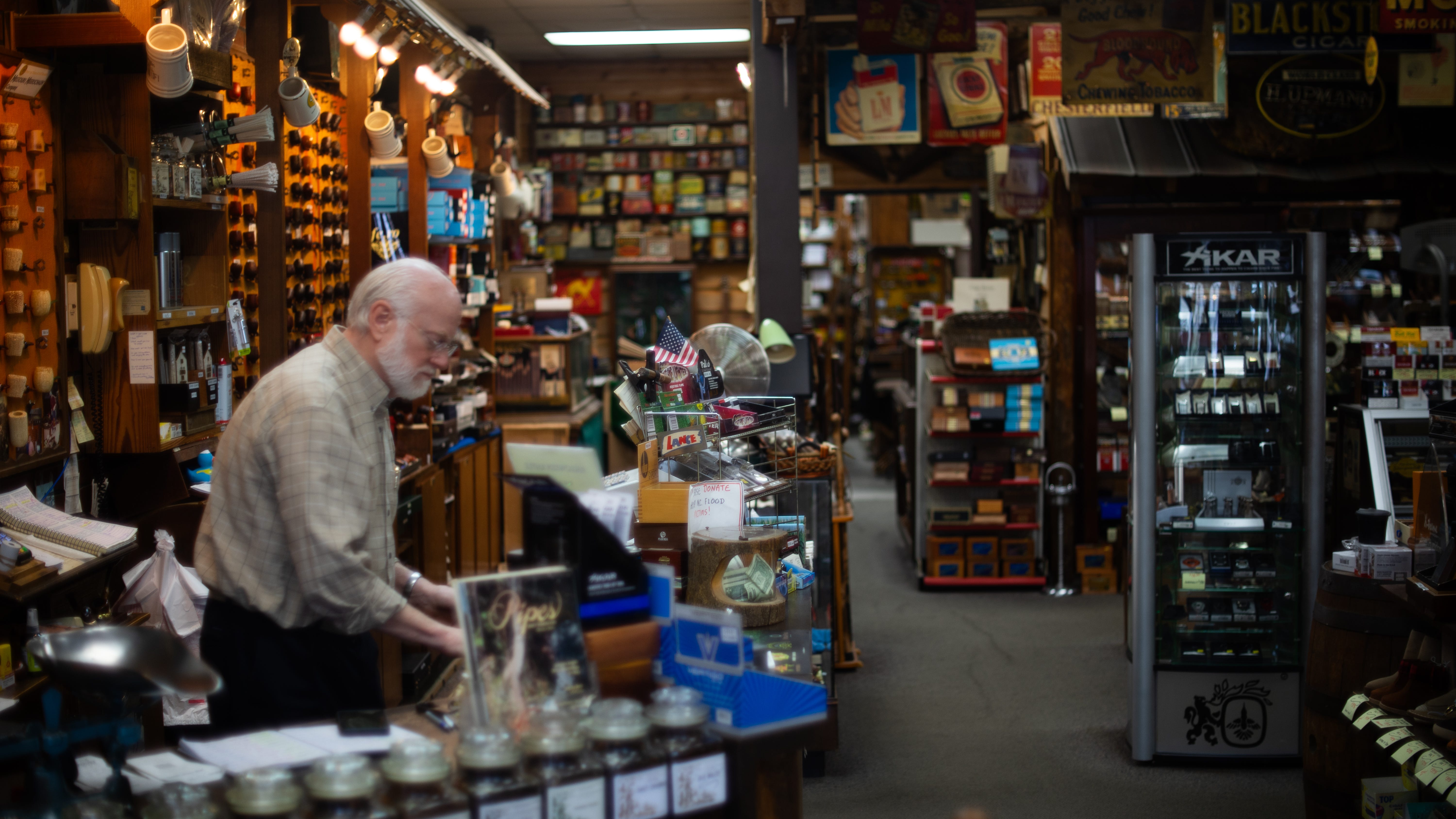
That is essentially what Tim has done with pipe smoking. He kept the pipes on the shelves, kept learning about them, kept smoking them and, most importantly, kept the knowledge of how to do it properly alive. Then, when a new generation suddenly became interested, he was still there behind the counter, ready to teach them.
Personally, I think Tim is one of the most genuine people you are likely to meet. He has built a little world around himself of craftsmanship, taste, timelessness, passion, and serious attention to the way things ought to be. It is the kind of place that makes you wish there were a Davis & Son in every city, not simply because of the tobacco on the shelves, but because there should still be places where the man behind the counter really knows what he is talking about.
For years, the world seemed to have little use for pipe smoking, the traditional tobacconist, or much of the knowledge Tim had spent a lifetime accumulating.
Tim never changed.
The world simply discovered him.
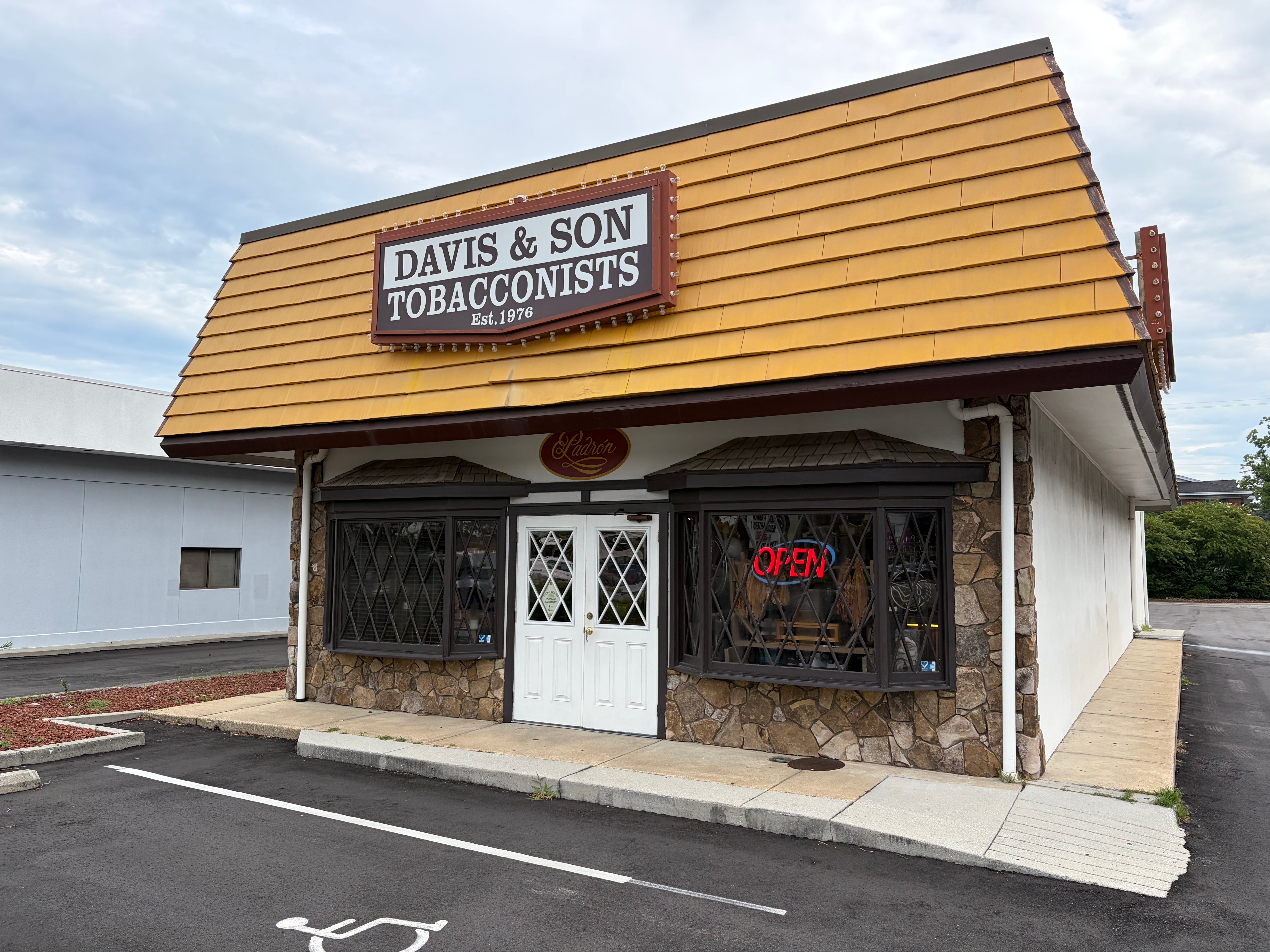
Thank you for reading about Tim Davis and his wonderful Tobacconists.
How to Follow and Buy From Tim:
Please follow him on his Instagram
To buy from him, go to his website and look at his inventory. Then call him as all purchases must be made over the phone. It’s a nice thought that it is always him on the line, or sometimes his wife. The man himself is always within reach. Even if all you have is a pipe-smoking question for him.
Wonderful article! I’m also a wilmington local and can verify that Tim and his shop are a treasure.
What a wonderful and well written article. I have been in that shop at least a dozen times during my travels to NC the past 30 years. It is everything you described and really needs to be experienced to truly enjoy. Wonderful!
Thank you!